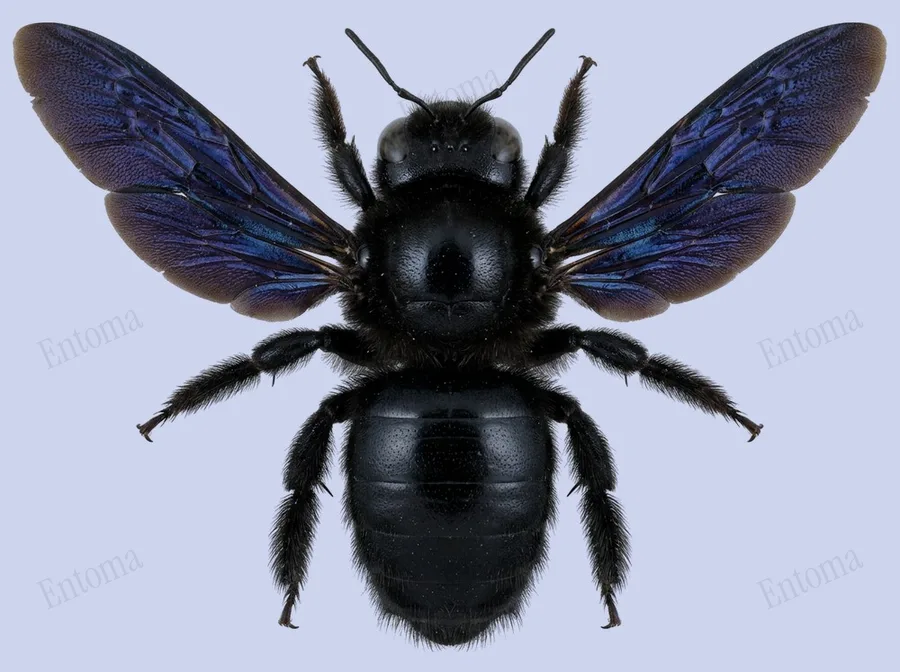
Violet carpenter bee
The Violet carpenter bee's sting is unusually painful for its size, though its venom is about six times weaker than a honeybee's and rarely causes swelling.
| Where | Gardens, old wood and open flowers |
|---|---|
| Size | 20 to 25 mm body length |
| When | February to September |
One of the largest solitary bees in Europe at up to two and a half centimeters long, the Violet carpenter bee is jet black with a striking metallic violet blue sheen across its wings.
Females gnaw nest tunnels into dead or soft living wood using their powerful mandibles, and because the species has no hive to defend, it is generally docile and stings only if directly handled.
Traits
Habitat
Garden
Colour
Black, Blue, Metallic
Active
Day
To people
Mild
Docile unless physically handled; only females can sting, and they rarely do since the species defends no hive.
Activity through the year
Often confused with
Similar size at about 20 to 28 mm, but black with purple-tinted hairs overall rather than the smooth violet sheen confined mainly to the wings of the Violet carpenter bee.
Questions
Is the Violet carpenter bee dangerous to people?
Mild. Docile unless physically handled; only females can sting, and they rarely do since the species defends no hive.
When can you see the Violet carpenter bee?
The Violet carpenter bee can be seen from February to September, by day.
Plate retouched from a museum specimen photo by Gago Carrión, Sergi, Museu de Ciències Naturals de Barcelona, CC BY 4.0, GBIF Licence
Report a mistake in this entry
Bees, wasps and ants›Bees and bumblebees›Xylocopa
Last updated 2026-09-26. Every entry is checked against published sources.