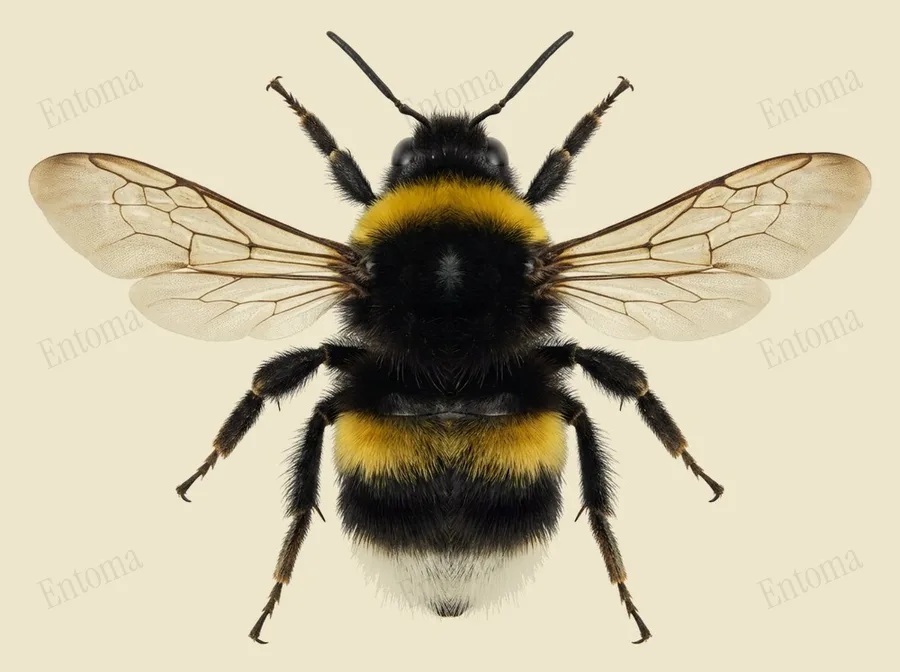
Vestal cuckoo bumble bee
Females of this cuckoo bee invade nests of the buff-tailed bumblebee, subdue or kill its queen, and force the workers to raise their young.
| Where | Gardens and open grassland |
|---|---|
| Size | 15 to 24 mm long |
| When | March to August |
This black bee has a bright yellow collar and a conspicuous yellow patch on each side of the abdomen; it lacks pollen baskets on the hind legs since it never forages for its own brood, and its thicker cuticle helps it survive host workers' stings. Females measure 20 to 24 mm long, males 15 to 19 mm.
It is a brood parasite of the buff-tailed bumblebee, entering established nests to lay its own eggs, and is found visiting flowers in gardens and open grassland from spring into late summer.
Traits
Habitat
Garden
Colour
Black, Yellow
Active
Day
To people
Mild
Females can sting, as with other bumblebees, but this species rarely bothers people.
Activity through the year
Often confused with
This other cuckoo bee is a similar size, about 11 to 23 mm long, but has smaller, less distinct pale side patches than the vestal cuckoo bumble bee's bold yellow markings.
Questions
Is the Vestal cuckoo bumble bee dangerous to people?
Mild. Females can sting, as with other bumblebees, but this species rarely bothers people.
When can you see the Vestal cuckoo bumble bee?
The Vestal cuckoo bumble bee can be seen from March to August, by day.
Plate retouched from a photo by Michael Garlick, CC BY‑SA 2.0, Wikimedia Commons Licence
The plate on this page is shared under the same licence as its source, CC BY-SA.
Report a mistake in this entry
Bees, wasps and ants›Bees and bumblebees›Bombus
Last updated 2026-09-26. Every entry is checked against published sources.