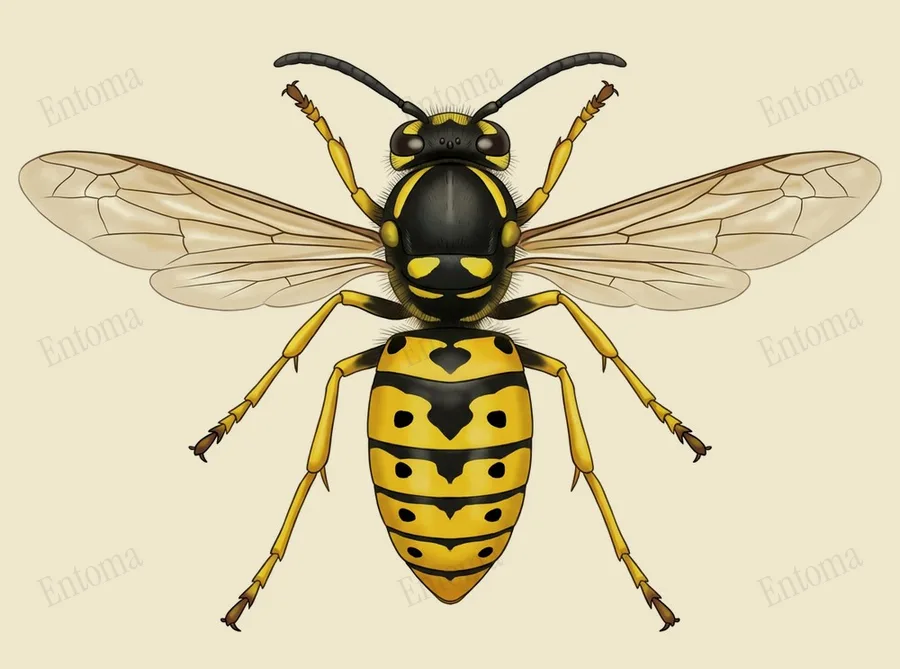
Common European yellowjacket
A queen builds the first paper cells herself from chewed wood pulp and saliva before her first workers take over construction.
| Where | Woodland, gardens, urban areas, almost everywhere |
|---|---|
| Size | 12 to 17 mm workers, queens to about 20 mm |
| When | March to November |
Workers show a black anchor- or dagger-shaped mark on the face and mostly fused black spots along a yellow-and-black banded abdomen.
Colonies are founded each spring by a single queen and can grow to several thousand workers by late summer before dying off in autumn.
Traits
Habitat
Towns
Colour
Yellow, Black
Active
Day
To people
Take care
Can sting if the nest is disturbed; not usually aggressive away from the nest.
Activity through the year
Often confused with
The German wasp usually shows three black dots on the face and separate black dots on the abdomen, where the common wasp's markings are fused.
Questions
Is the Common European yellowjacket dangerous to people?
Take care. Can sting if the nest is disturbed; not usually aggressive away from the nest.
When can you see the Common European yellowjacket?
The Common European yellowjacket can be seen from March to November, by day.
Plate retouched from a photo by Trounce, CC BY 3.0, Wikimedia Commons Licence
Report a mistake in this entry
Bees, wasps and ants›Wasps and hornets›Vespula
Last updated 2026-09-26. Every entry is checked against published sources.