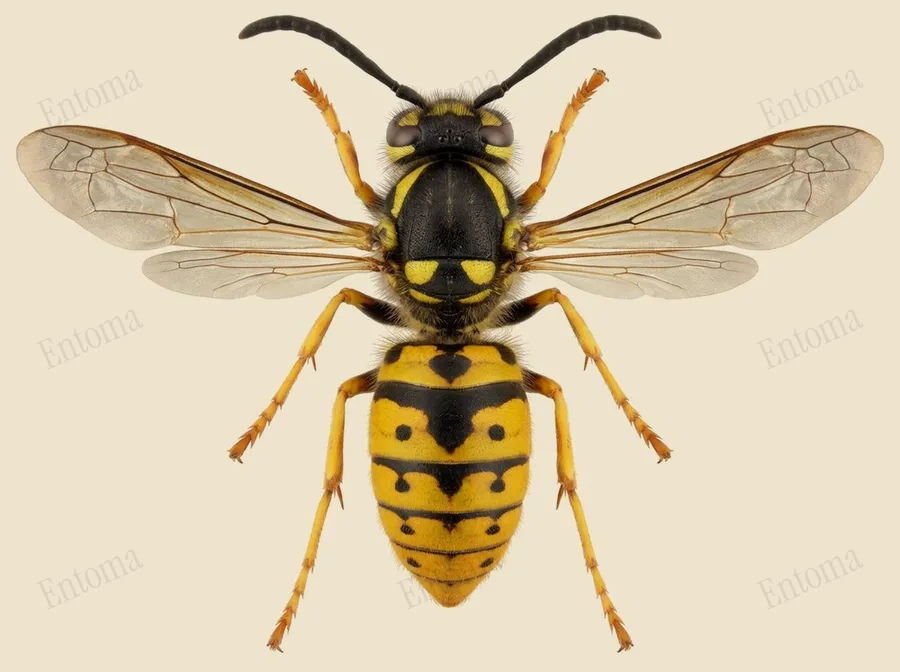
German yellowjacket
A German yellowjacket nest lasts one season; a queen starts it alone in spring, and workers, which can sting repeatedly without dying, abandon it by autumn.
| Where | Forest edges, farmland and towns |
|---|---|
| Size | 12 to 20 mm body length |
| When | March to November |
The German yellowjacket is black and yellow with bold markings, including an arrow shaped mark down the center of the abdomen and, unlike the common wasp, three small black dots on the front of its face.
A single fertilized queen starts the nest alone each spring, and by late summer a mature colony can hold several thousand workers before the whole nest is abandoned for good at the end of the season.
Traits
Habitat
Towns
Colour
Black, Yellow
Active
Day
To people
Take care
Stings if its nest is disturbed and, unlike a honeybee, can sting more than once without dying.
Activity through the year
Often confused with
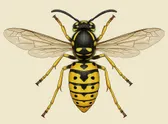
Similar in size at about 12 to 17 mm, but told apart by the face: the common wasp shows one anchor shaped black mark rather than the three dots of the German yellowjacket.
Questions
Is the German yellowjacket dangerous to people?
Take care. Stings if its nest is disturbed and, unlike a honeybee, can sting more than once without dying.
When can you see the German yellowjacket?
The German yellowjacket can be seen from March to November, by day.
Plate retouched from a museum specimen photo by Malinen, Pekka, Finnish Museum of Natural History - Zoology Unit, CC BY 4.0, GBIF Licence
Report a mistake in this entry
Bees, wasps and ants›Wasps and hornets›Vespula
Last updated 2026-09-26. Every entry is checked against published sources.