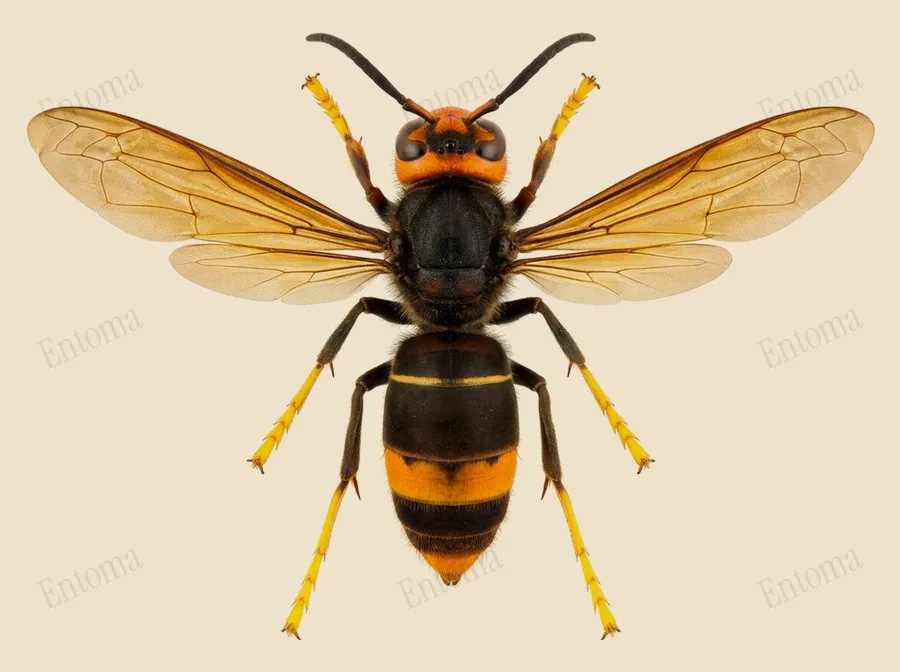
Yellow-legged hornet
It hunts honeybees by hovering in front of a hive entrance and snatching foragers out of the air as they return home, rather than raiding the nest itself.
| Where | Woodland edges, orchards, urban trees |
|---|---|
| Size | 20 to 30 mm long |
| When | April to May, July to December |
It is darker overall than native hornets, with a velvety black or brown body, yellow-tipped legs, and just one orange band near the tip of the abdomen.
Colonies build large aerial nests, often high in trees, and workers specialise in catching honeybees, which is why the species is treated as a serious threat to beekeeping where it has spread.
Traits
Habitat
Woodland
Colour
Black, Orange, Yellow
Active
Day
To people
Take care
Invasive predator of honeybees; not more aggressive toward humans than native hornets unless its nest is disturbed
Activity through the year
Often confused with
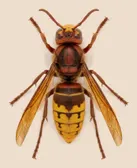
The European hornet is larger, with a yellow face and an abdomen banded yellow and black along its whole length, unlike the yellow-legged hornet's mostly dark abdomen with a single orange band.
Questions
Is the Yellow-legged hornet dangerous to people?
Take care. Invasive predator of honeybees; not more aggressive toward humans than native hornets unless its nest is disturbed.
When can you see the Yellow-legged hornet?
The Yellow-legged hornet can be seen from April to May, July to December, by day.
Plate retouched from a photo by Didier Descouens, CC BY‑SA 4.0, Wikimedia Commons Licence
The plate on this page is shared under the same licence as its source, CC BY-SA.
Report a mistake in this entry
Bees, wasps and ants›Wasps and hornets›Vespa
Last updated 2026-09-26. Every entry is checked against published sources.