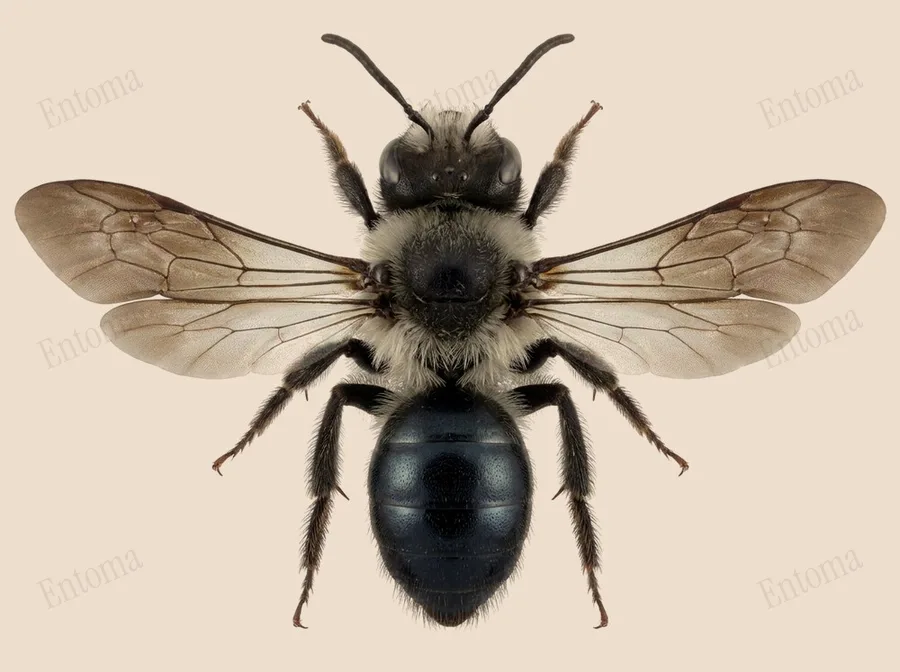
Ashy mining bee
Ashy mining bees nest alone, yet hundreds of females often dig side by side in the same sunny lawn or bank, forming a dense solitary neighborhood.
| Where | Lawns, banks and open grassland |
|---|---|
| Size | 10 to 15 mm body length |
| When | March to June |
Females are glossy blue black with two broad ash grey hair bands across the thorax and grey hairs on the face, while males are slimmer with grey hair covering the whole thorax and noticeably longer antennae.
Active from March to June, it digs a burrow ten to twenty centimeters deep in bare or short turfed ground, and although it nests alone, hundreds of females often choose the same sunny bank or lawn.
Traits
Habitat
Grassland
Colour
Black, Grey
Active
Day
To people
Mild
Docile around people; females carry a weak sting that rarely breaks skin, and its burrows in lawns and banks cause no lasting damage.
Activity through the year
Often confused with
Similar in size at about 13 to 15 mm, but its thorax is uniformly grey, while the Ashy mining bee shows a dark band splitting its two grey hair bands.
Questions
Is the Ashy mining bee dangerous to people?
Mild. Docile around people; females carry a weak sting that rarely breaks skin, and its burrows in lawns and banks cause no lasting damage.
When can you see the Ashy mining bee?
The Ashy mining bee can be seen from March to June, by day.
Plate retouched from a museum specimen photo by Malinen, Pekka, Finnish Museum of Natural History - Zoology Unit, CC BY 4.0, GBIF Licence
Report a mistake in this entry
Bees, wasps and ants›Mining bees›Andrena
Last updated 2026-09-26. Every entry is checked against published sources.