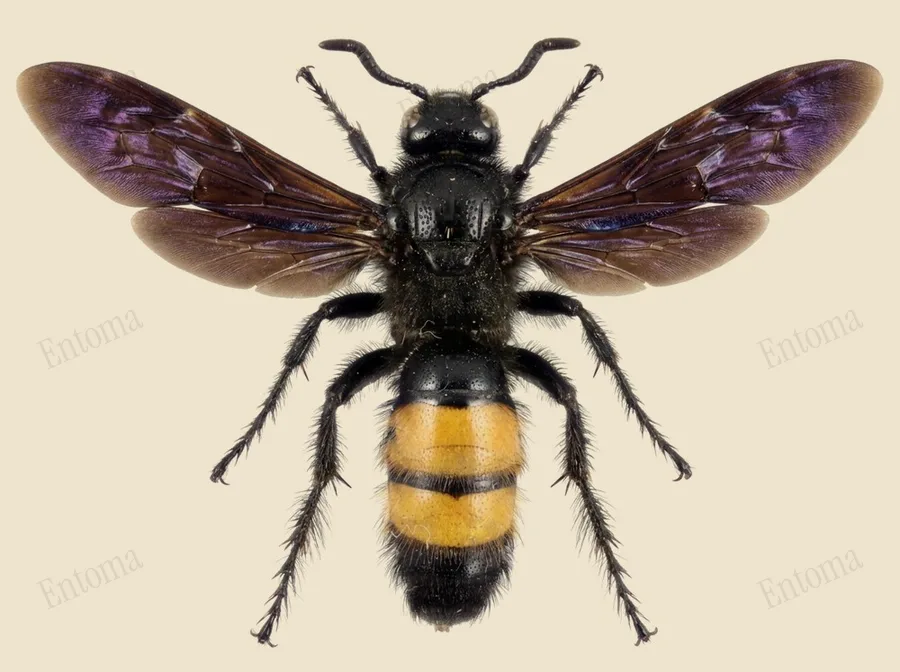
Hairy scoliid wasp
Female wasps of this species dig into sandy soil to find and sting beetle grubs, then lay a single egg on the paralyzed larva.
| Where | Dry, sandy grassland and dunes |
|---|---|
| Size | 13 to 22 mm body length |
| When | June to September |
This wasp is glossy black with two bright yellow bands across the abdomen and smoky, dark tinted wings that show a metallic sheen in strong light. Females are somewhat larger and stockier than males, which have longer antennae and lack a sting.
Females burrow into loose, sandy soil on warm, sparsely vegetated ground to find beetle grubs, which they sting and paralyze before laying a single egg on each one. Adults also visit flowers to feed and are most active in mid to late summer.
Traits
Habitat
Grassland
Colour
Black, Yellow
Active
Day
To people
Mild
Solitary and not aggressive toward people; females can sting if handled but rarely do, and males have no sting at all.
Activity through the year
Often confused with
Much larger at 45 to 50 mm long with a yellow head in females, compared to the Hairy scoliid wasp, which never exceeds about 22 mm.
Questions
Is the Hairy scoliid wasp dangerous to people?
Mild. Solitary and not aggressive toward people; females can sting if handled but rarely do, and males have no sting at all.
When can you see the Hairy scoliid wasp?
The Hairy scoliid wasp can be seen from June to September, by day.
Plate retouched from a museum specimen photo by Jordan Andrea, Kirchweger Stefan, Biologiezentrum Linz Oberoesterreich, CC0, GBIF Licence
Report a mistake in this entry
Bees, wasps and ants›Scoliid wasps›Scolia
Last updated 2026-09-26. Every entry is checked against published sources.