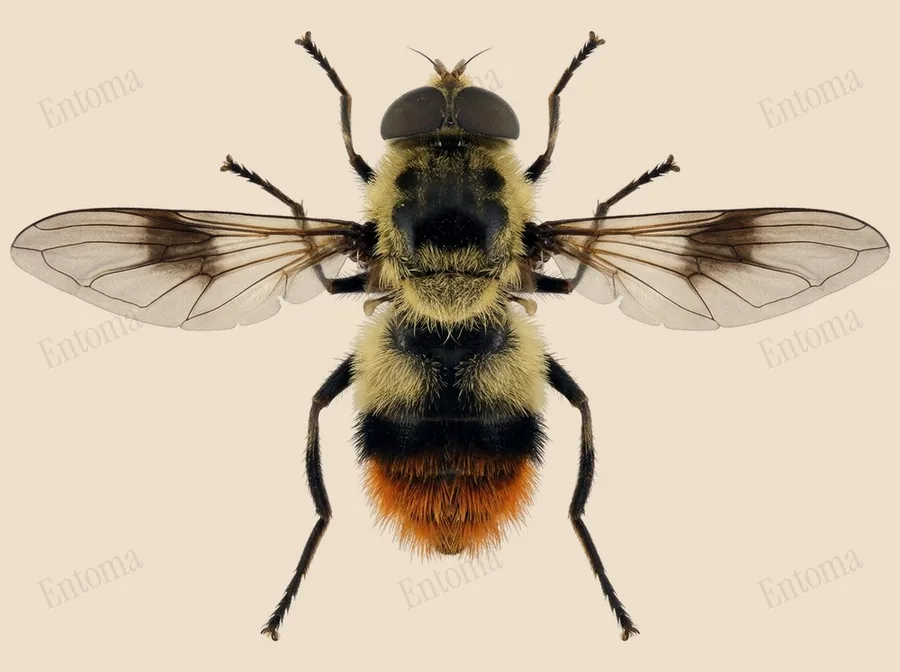
Bumblebee blacklet
This fly's furry, black and orange body mimics a bumblebee so closely that it is often mistaken for one while feeding on hogweed flowers.
| Where | Hedgerows and woodland edges |
|---|---|
| Size | 9 to 11 mm body length |
| When | May to August |
This hoverfly is a furry bumblebee mimic with pale hairs over most of the body, a black band across the thorax, another across the third abdominal segment, and a smoky patch in the center of each wing.
Adults feed mainly at hogweed and other umbellifer flowers in hedgerows and woodland edges, while larvae tunnel into the roots of hogweed plants during autumn. It is harmless to people and does not sting or bite.
Traits
Habitat
Woodland
Colour
Black, Orange
Active
Day
To people
Harmless despite its bumblebee like appearance; it cannot sting or bite.
Activity through the year
Often confused with
A larger bumblebee mimic at about 11 to 17 mm, with fuller colored fur bands imitating specific bumblebee species, rather than the more uniformly pale hair of the Bumblebee blacklet.
Questions
Is the Bumblebee blacklet dangerous to people?
Harmless despite its bumblebee like appearance; it cannot sting or bite.
When can you see the Bumblebee blacklet?
The Bumblebee blacklet can be seen from May to August, by day.
Plate retouched from a museum specimen photo by Gunnar Engan, Norwegian Biodiversity Information Centre, CC BY 4.0, GBIF Licence
Report a mistake in this entry
Last updated 2026-09-26. Every entry is checked against published sources.