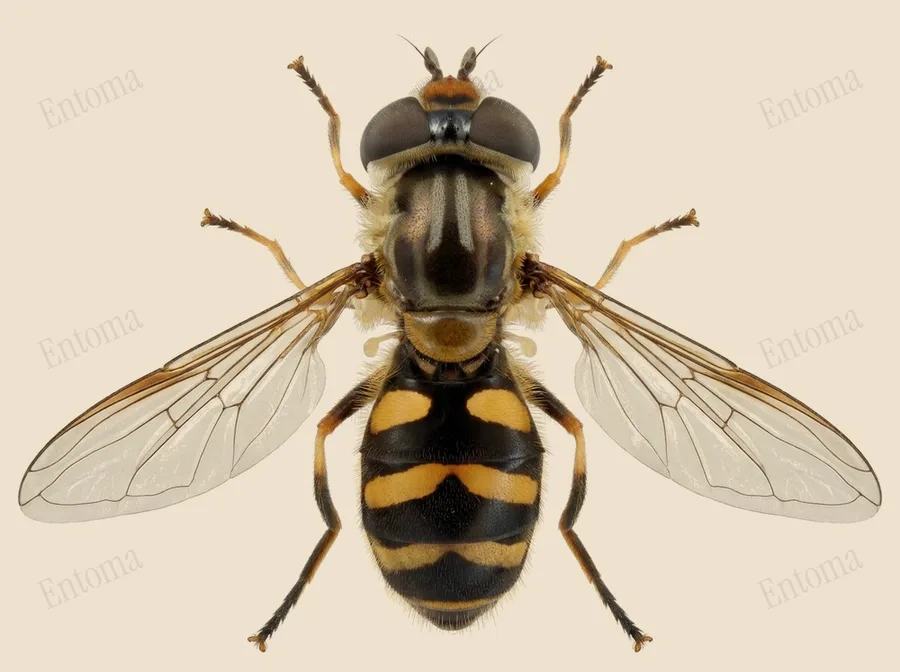
Stripe-backed hoverfly
Two pale dusty stripes run down the thorax of this hoverfly, a pattern shared by only a few close relatives among Europe's many black and yellow hoverflies.
| Where | Woodland edges and coniferous forest |
|---|---|
| Size | 6.25 to 9.5 mm wing length |
| When | April to October |
The Stripe-backed hoverfly has a shining black thorax marked with two parallel stripes of grey dust, a yellow face and legs, and a black abdomen crossed by diagonal yellow bars that can fuse into inverted V shapes.
Two generations fly each year, the first darker than the second, with adults visiting flowers at woodland edges and clearings while their larvae hunt aphids on trees and shrubs.
Traits
Habitat
Woodland
Colour
Black, Yellow, Grey
Active
Day
To people
Cannot sting or bite; adults visit flowers and pose no risk to people.
Activity through the year
Often confused with
Similar in size at 6.25 to 10 mm wing length, told apart by a black stripe down the face and an equally broad pale patch on the second abdominal segment.
Questions
Is the Stripe-backed hoverfly dangerous to people?
Cannot sting or bite; adults visit flowers and pose no risk to people.
When can you see the Stripe-backed hoverfly?
The Stripe-backed hoverfly can be seen from April to October, by day.
Plate retouched from a photo by Janet Graham, CC BY 2.0, Wikimedia Commons Licence
Report a mistake in this entry
Last updated 2026-09-26. Every entry is checked against published sources.