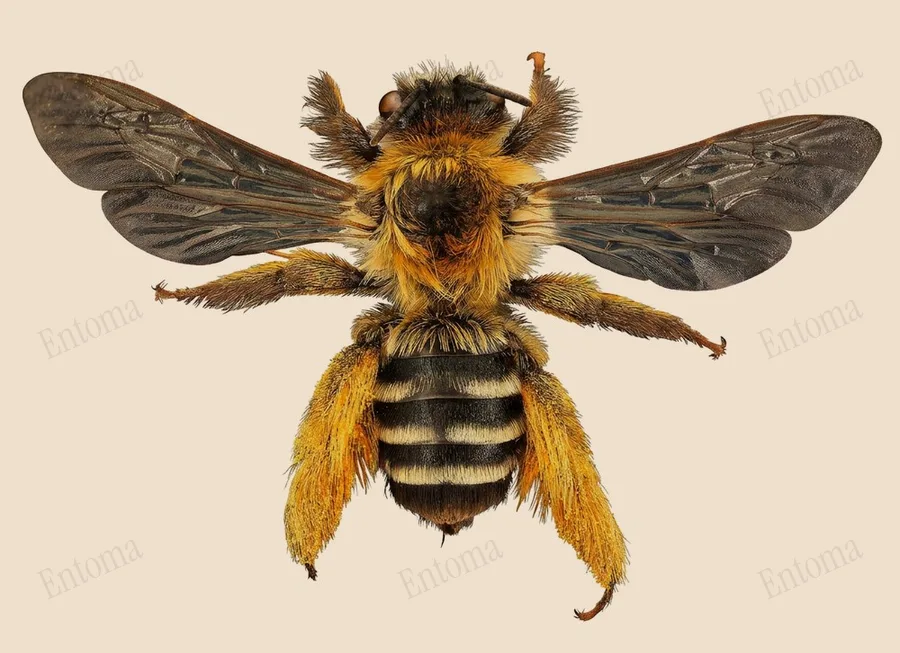
Common pantaloon bee
Females grow such dense, pollen-laden hair on their hind legs that they appear to be wearing fluffy golden pantaloons while foraging.
| Where | Sandy heaths, dunes, and cliffs |
|---|---|
| Size | 9 to 11 mm long |
| When | June to August |
This bee has a golden-brown thorax and a black-and-golden-brown banded abdomen; females carry extremely long, dense golden hairs on the hind legs that swell with collected pollen, and the body reaches about 9 to 11 mm long.
A solitary mining bee, it digs long, angled burrows in sparsely vegetated sandy ground, sometimes in large nesting aggregations, and forages on daisy-family flowers such as knapweed and hawkbit.
Traits
Habitat
Heath
Colour
Yellow, Black, Brown
Active
Day
To people
Females carry a sting, but it is too weak to pierce human skin, so nesting aggregations are harmless to walkers and pets.
Activity through the year
Often confused with
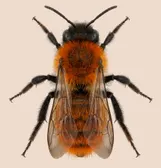
The tawny mining bee is a similarly furry, orange-brown bee but smaller at 8 to 12 mm long, and its females lack the dense golden pollen brush on the hind legs that gives the pantaloon bee its name.
Questions
Is the Common pantaloon bee dangerous to people?
Females carry a sting, but it is too weak to pierce human skin, so nesting aggregations are harmless to walkers and pets.
When can you see the Common pantaloon bee?
The Common pantaloon bee can be seen from June to August, by day.
Plate retouched from a photo by USGS Bee Inventory and Monitoring Lab from Beltsville, Maryland, USA, Public domain, Wikimedia Commons Public domain
Report a mistake in this entry
Bees, wasps and ants›Melittid bees›Dasypoda
Last updated 2026-09-26. Every entry is checked against published sources.