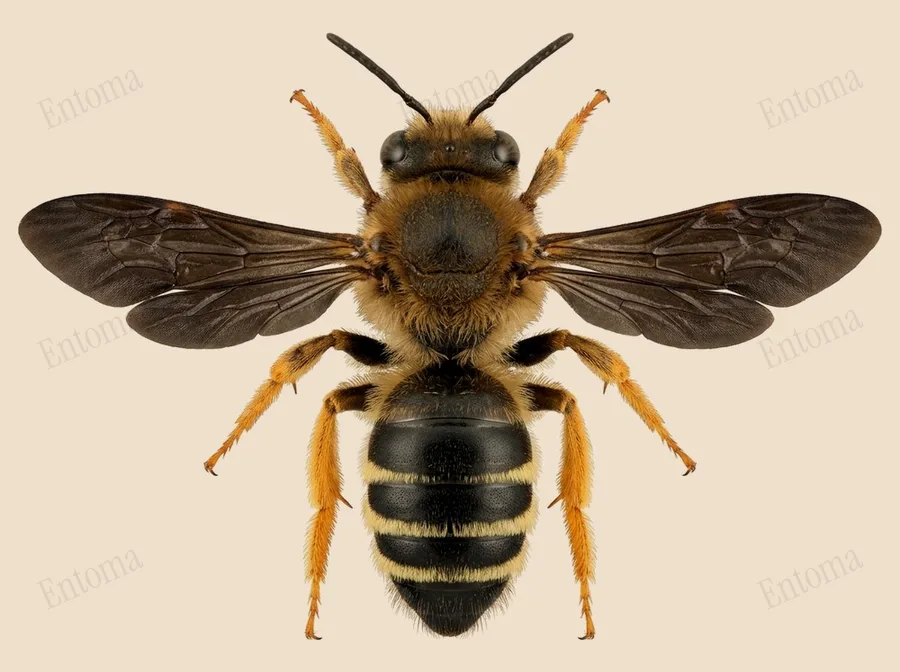
Great banded furrow bee
Although it looks like a solitary bee, some of its nests are shared by several egg-laying females who turn out to be full sisters.
| Where | Bare ground, paths, grassland |
|---|---|
| Size | 12 to 15 mm long |
| When | May to September |
This is a fairly large furrow bee with a long abdomen marked by pale, hair-based bands and yellow legs. Males are noticeably slender with a pale band near the tip of the abdomen, while females show yellowish-beige hair bands instead.
It nests in burrows dug into hardened, bare ground, and while many nests are started by a single female, a good number are shared by two or more egg-laying females, some of them close relatives, forming a partly social colony.
Traits
Habitat
Grassland
Colour
Black, Yellow, Brown
Active
Day
To people
Mild
Not aggressive; only females can sting and rarely do
Activity through the year
Often confused with
Male six-banded furrow bees have longer, reddish antennae, and females lack the pale basal hair bands seen on the great banded furrow bee.
Questions
Is the Great banded furrow bee dangerous to people?
Mild. Not aggressive; only females can sting and rarely do.
When can you see the Great banded furrow bee?
The Great banded furrow bee can be seen from May to September, by day.
Plate retouched from a photo by USGS Bee Inventory and Monitoring Lab from Beltsville, Maryland, USA, Public domain, Wikimedia Commons Public domain
Report a mistake in this entry
Bees, wasps and ants›Sweat bees›Halictus
Last updated 2026-09-26. Every entry is checked against published sources.