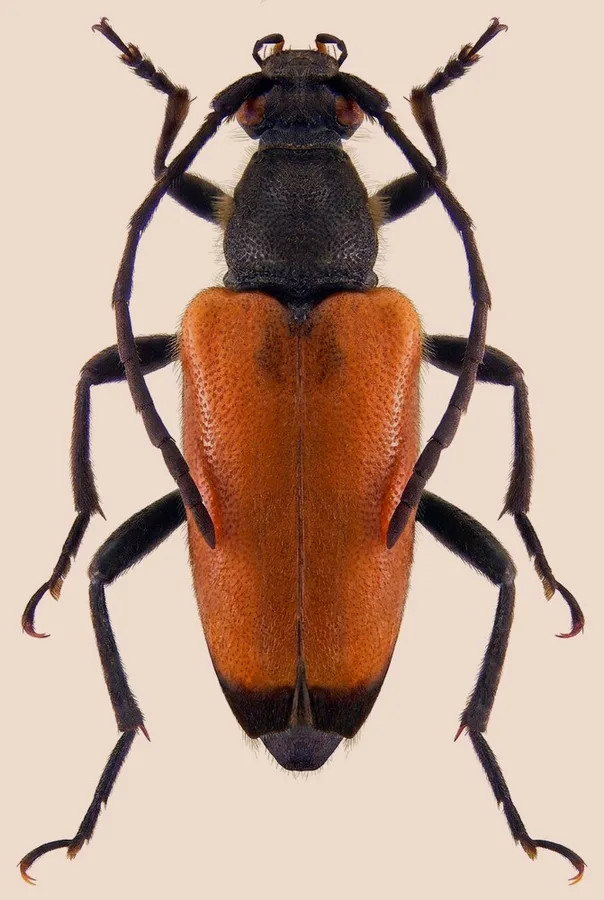
Tawny longhorn beetle
This golden brown longhorn beetle with black wing tips is common in southern and western Europe and thins out quickly toward the north of its range.
| Where | Broadleaved woodland, mainly near the coast |
|---|---|
| Size | 9 to 14 mm body length |
| When | June to August |
The wing covers are golden brown with black tips, and the legs and antennae are black. Females tend to be slightly larger than males.
Larvae develop in the decaying wood of poplar, oak and willow. Adults are diurnal and visit flowers from June to August, and at the northern edge of the range they are mostly confined to warm broadleaved woodland near the coast.
Traits
Habitat
Woodland
Colour
Brown, Black
Active
Day
To people
Harmless to people; adults are seen by day visiting flowers for pollen.
Activity through the year
Often confused with
Similar size or slightly larger, 10 to 20 mm, with females uniformly reddish brown and males black headed with paler elytra, lacking the sharp black wing tips of the tawny longhorn beetle.
Questions
Is the Tawny longhorn beetle dangerous to people?
Harmless to people; adults are seen by day visiting flowers for pollen.
When can you see the Tawny longhorn beetle?
The Tawny longhorn beetle can be seen from June to August, by day.
Plate retouched from a photo by Udo Schmidt from Deutschland, CC BY‑SA 2.0, Wikimedia Commons Licence
The plate on this page is shared under the same licence as its source, CC BY-SA.
Report a mistake in this entry
Beetles›Longhorn beetles›Paracorymbia
Last updated 2026-09-26. Every entry is checked against published sources.