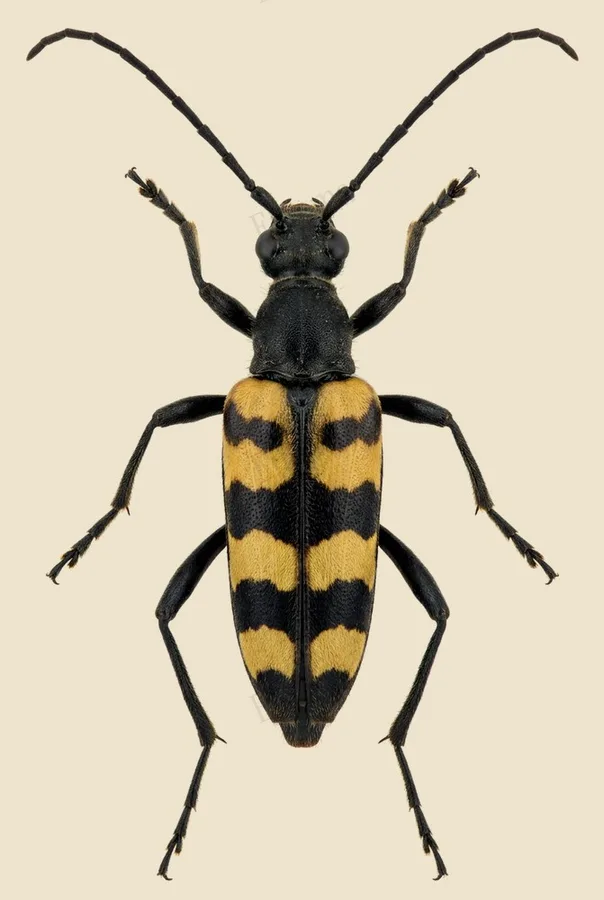
Four-banded longhorn beetle
This longhorn beetle's four yellow bands are so regular that they help tell it apart from its blotchier relative, the spotted longhorn beetle, at a glance.
| Where | Old woodland and flowering meadows |
|---|---|
| Size | 11 to 20 mm body length |
| When | June to August |
The four-banded longhorn beetle is a black beetle crossed by four neat, evenly shaped yellow bands running across its wing cases, though the bands can be reduced in some individuals. Its long antennae and elongated body are typical of the longhorn beetle family.
Adults are usually seen on flowers, especially umbellifers, in summer, where they feed on pollen and nectar. The larvae develop inside decaying wood, tunneling through old tree trunks, stumps and fallen logs for one or more years before emerging as adults.
Traits
Habitat
Woodland
Colour
Black, Yellow
Active
Day
To people
Often seen feeding on flowers in summer; harmless to handle and does not sting.
Activity through the year
Often confused with
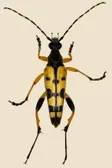
Similar in size at about 13 to 20 mm, but with larger, more irregular and blotchy yellow markings and yellow rather than black legs.
Questions
Is the Four-banded longhorn beetle dangerous to people?
Often seen feeding on flowers in summer; harmless to handle and does not sting.
When can you see the Four-banded longhorn beetle?
The Four-banded longhorn beetle can be seen from June to August, by day.
Plate retouched from a photo by Francisco Welter-Schultes, CC0, Wikimedia Commons Licence
Report a mistake in this entry
Beetles›Longhorn beetles›Leptura
Last updated 2026-09-26. Every entry is checked against published sources.