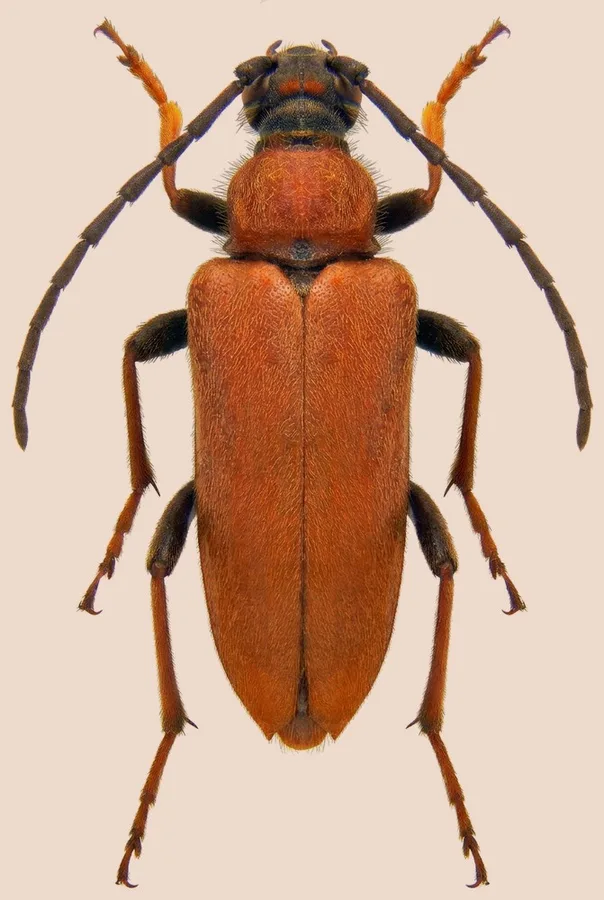
Red pine longhorn beetle
Males and females look so different that they could pass for separate species: males have a black head with pale wing cases, females glow uniformly reddish-orange.
| Where | Coniferous forest, pine stumps |
|---|---|
| Size | 10 to 20 mm long |
| When | June to August |
This longhorn beetle shows striking differences between the sexes: males have a black head and pronotum with pale buff-brown wing cases, while females are larger and broader, with wing cases and pronotum that are uniformly reddish-orange.
Larvae develop over two to three years inside dead wood and stumps of conifers such as pine and spruce, and adults are most often seen visiting flowers in July and August.
Traits
Habitat
Woodland
Colour
Red, Black, Brown
Active
Day
To people
Harmless
Activity through the year
Often confused with
The blood-red longhorn beetle is smaller, at 8 to 13 mm, and keeps a black head, antennae and pronotum in both sexes, unlike the female red pine longhorn beetle's uniformly reddish body.
Questions
Is the Red pine longhorn beetle dangerous to people?
The Red pine longhorn beetle is harmless to people.
When can you see the Red pine longhorn beetle?
The Red pine longhorn beetle can be seen from June to August, by day.
Plate retouched from a photo by Udo Schmidt from Deutschland, CC BY‑SA 2.0, Wikimedia Commons Licence
The plate on this page is shared under the same licence as its source, CC BY-SA.
Report a mistake in this entry
Beetles›Longhorn beetles›Stictoleptura
Last updated 2026-09-26. Every entry is checked against published sources.