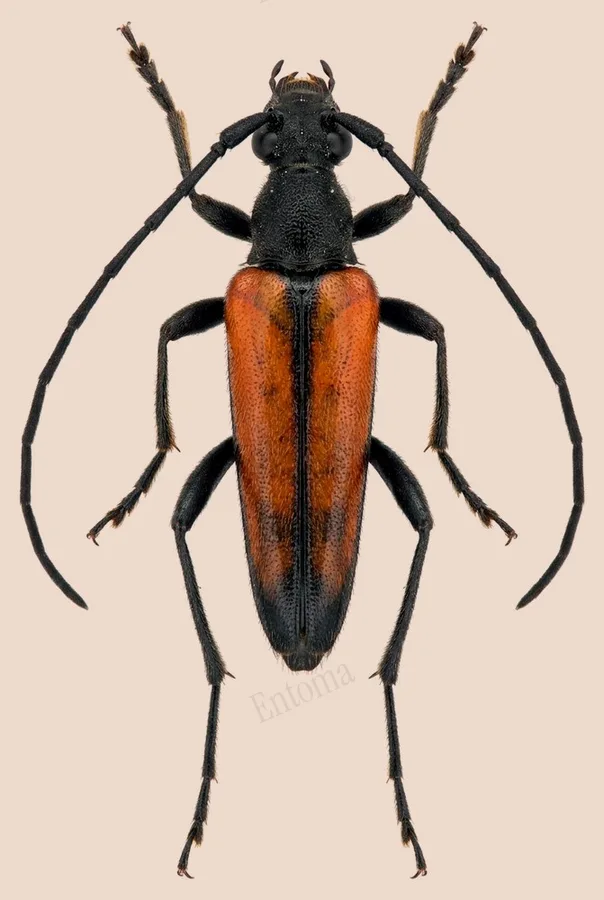
Black-striped longhorn beetle
Adults are common flower visitors that feed on pollen and nectar, while the larvae take up to two years to develop inside rotting wood, especially sweet chestnut.
| Where | Sunny forest edges and clearings |
|---|---|
| Size | 6 to 10 mm long |
| When | May to August |
The black-striped longhorn beetle is a slender, narrow bodied longhorn with antennae about as long as its body. Males have yellow brown elytra narrowly edged in black, while females have redder elytra with a much broader black seam and tip.
It is a frequent visitor to open flowers such as oxeye daisy and yarrow, where it feeds on pollen, and its larvae take up to two years to develop inside the rotting wood of deciduous and coniferous trees.
Traits
Habitat
Woodland
Colour
Black, Brown, Yellow
Active
Day
To people
Harmless; it does not bite or sting people.
Activity through the year
Often confused with
The two-banded longhorn beetle is similar in size, but females show a black heart-shaped or rhomboid marking on the elytra that black-striped longhorn beetle females lack.
Questions
Is the Black-striped longhorn beetle dangerous to people?
Harmless; it does not bite or sting people.
When can you see the Black-striped longhorn beetle?
The Black-striped longhorn beetle can be seen from May to August, by day.
Plate retouched from a photo by Francisco Welter-Schultes, CC0, Wikimedia Commons Licence
Report a mistake in this entry
Beetles›Longhorn beetles›Stenurella
Last updated 2026-09-26. Every entry is checked against published sources.