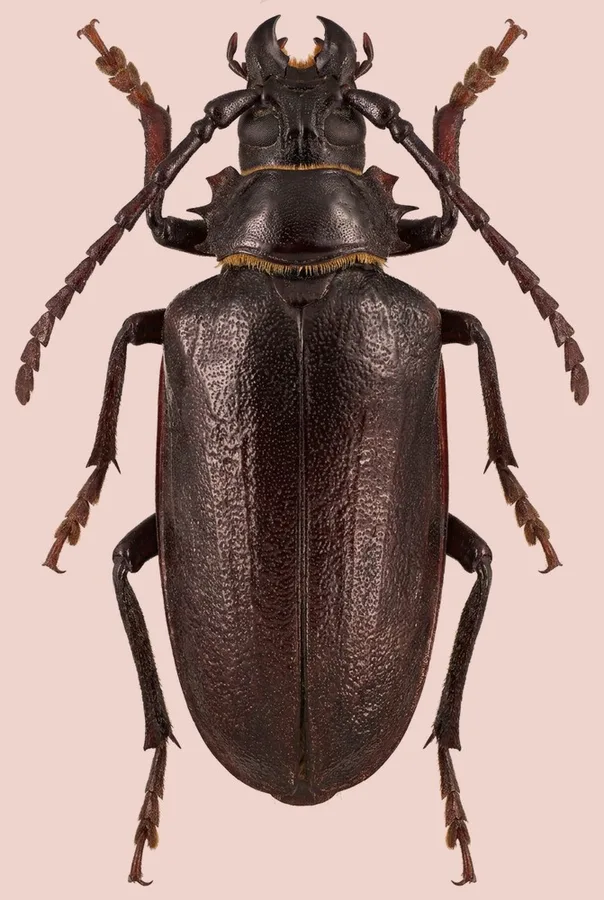
The tanner
The tanner is one of Europe's heaviest beetles, and although it eats nothing as an adult, its powerful jaws can still pinch hard enough to break skin.
| Where | Old deciduous woodland and wooded parkland |
|---|---|
| Size | 18 to 45 mm body length |
| When | June to August |
The tanner is a heavyset, shiny dark brown to black beetle reaching 18 to 45 mm long, with females larger than males. Each side of its neck shield bears three distinct teeth, and the male's long antennae are strongly serrated like a saw, giving the species its common name.
Larvae take at least three years to develop, tunnelling through the decaying roots and rotten wood of both broadleaved and coniferous trees. Adults do not feed, appear from June to August, and fly mostly at dusk and after dark.
Traits
Habitat
Woodland
Colour
Black, Brown
Active
Night
To people
Adults do not sting, but the powerful mandibles can pinch painfully if the beetle is picked up, so it is best handled gently or not at all.
Activity through the year
Often confused with
Larger on average at 25 to 52 mm, with a softly hairy, yellowish brown to reddish body rather than the tanner's shiny dark brown to black, and its larvae develop in damp riverside and floodplain trees.
Questions
Is the The tanner dangerous to people?
Adults do not sting, but the powerful mandibles can pinch painfully if the beetle is picked up, so it is best handled gently or not at all.
When can you see the The tanner?
The The tanner can be seen from June to August, at night.
Plate retouched from a photo by Stanislav Snäll, CC BY 3.0, Wikimedia Commons Licence
Report a mistake in this entry
Beetles›Longhorn beetles›Prionus
Last updated 2026-09-26. Every entry is checked against published sources.