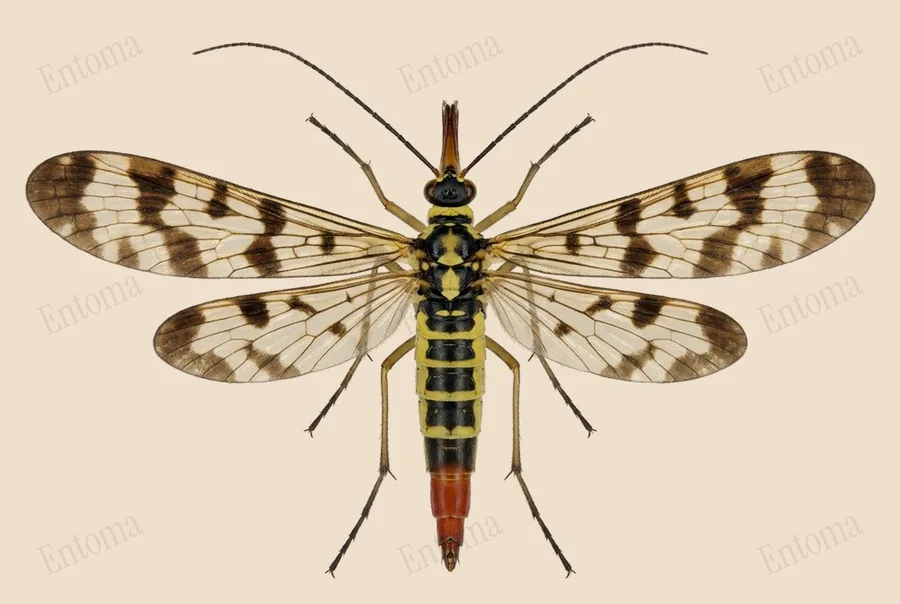
Meadow scorpionfly
Despite its name and the male's upturned tail resembling a scorpion's sting, this insect cannot sting or bite people at all.
| Where | Sunny meadows and hedgerows |
|---|---|
| Size | 10 to 18 mm long |
| When | April to September |
This brownish insect has patterned wings crossed with dark bands and blotches, a long beak-like face, and in males a bulbous genital capsule that curls upward like a scorpion's tail; the body reaches about 10 to 18 mm long.
Adults scavenge on dead insects, rotting fruit, and nectar in sunny meadows and hedgerows, flying from spring through the end of summer.
Traits
Habitat
Grassland
Colour
Brown, Black
Active
Day
To people
Harmless; despite its name it cannot sting or bite people.
Activity through the year
Often confused with
The common scorpionfly has a small or nearly absent dark spot at the base of the forewing, while the meadow scorpionfly's basal wing spot is larger and more prominent; both reach a similar body length.
Questions
Is the Meadow scorpionfly dangerous to people?
Harmless; despite its name it cannot sting or bite people.
When can you see the Meadow scorpionfly?
The Meadow scorpionfly can be seen from April to September, by day.
Plate retouched from a photo by Francisco Welter-Schultes, CC0, Wikimedia Commons Licence
Report a mistake in this entry
Scorpionflies›Common scorpionflies›Panorpa
Last updated 2026-09-26. Every entry is checked against published sources.