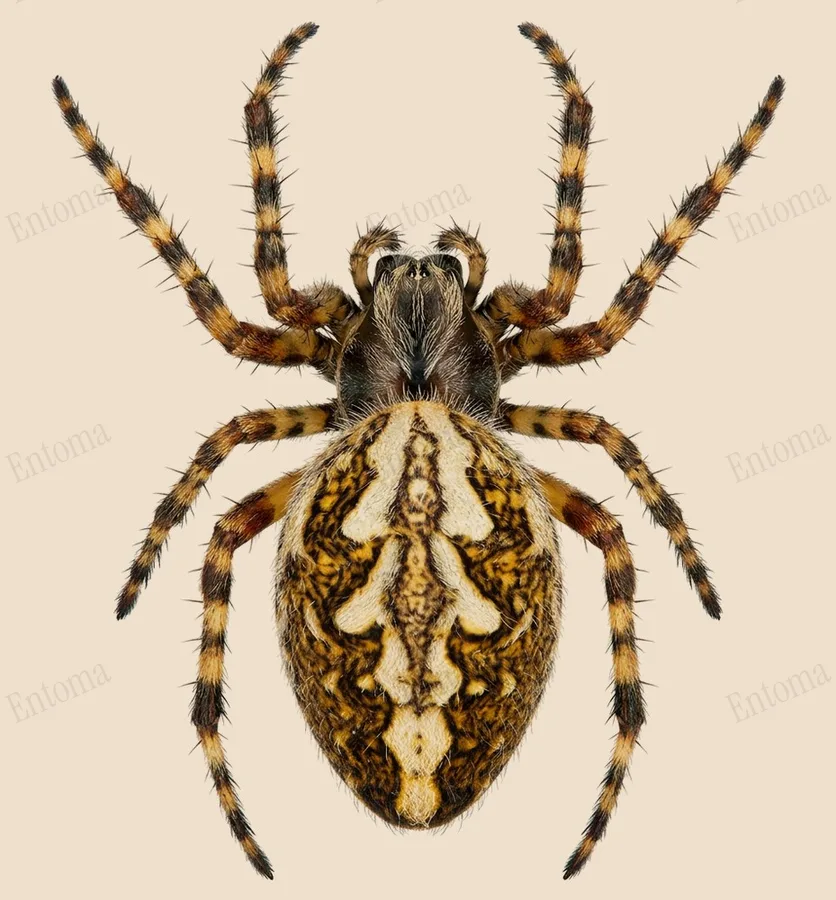
Oak spider
Despite its name, this orb weaver rarely lives near oak trees at all; it hunts instead in open meadows, mountain grassland and roadside scrub.
| Where | Open meadows, bushes and roadsides |
|---|---|
| Size | Male 6 to 8 mm, female 15 to 17 mm body length |
| When | May to September |
The oak spider is a robust orb weaver with reddish-brown, hairy legs banded in darker rings and a distinctive oak-leaf shaped marking across the abdomen, which gives the species its common name despite its meadow habits. Females are much larger than males, reaching 15 to 17 mm in body length against 6 to 8 mm.
It spins a large upright orb web in open, sunny and often windy places such as low bushes, wet meadows, roadsides and gardens, and can be found from lowland habitats up to mountain slopes above 3000 metres. Adults mature in early summer and lay eggs in early autumn before the first frosts.
Traits
Habitat
Grassland
Colour
Brown, Red
Active
Day
To people
Not known to bite people; it sits motionless in its web and is easily avoided if disturbed.
Activity through the year
Often confused with
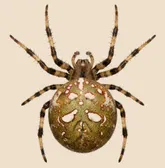
The four-spotted orb weaver always carries four rounded white spots on the abdomen whatever its base colour, whether brown, orange or green, while the oak spider is marked instead with a single oak-leaf shaped pattern and never shows four separate white spots.
Questions
Is the Oak spider dangerous to people?
Not known to bite people; it sits motionless in its web and is easily avoided if disturbed.
When can you see the Oak spider?
The Oak spider can be seen from May to September, by day.
Plate retouched from a museum specimen photo by Staatliche Naturwissenschaftliche Sammlungen Bayerns, CC BY 4.0, GBIF Licence
Report a mistake in this entry
Spiders›Orb-weaver spiders›Aculepeira
Last updated 2026-09-27. Every entry is checked against published sources.