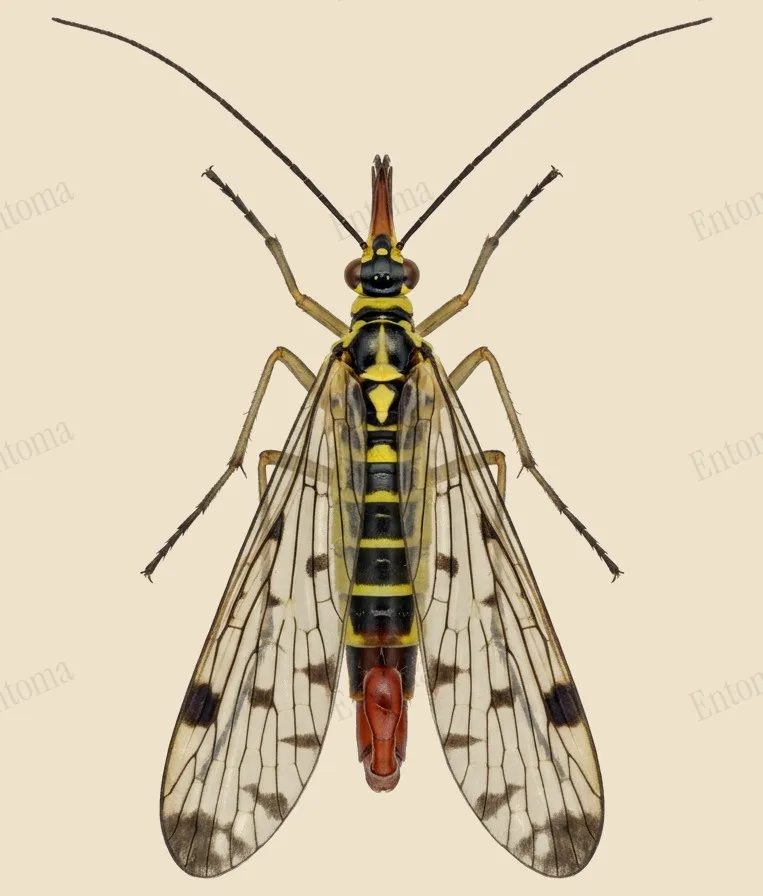
German scorpionfly
The male's swollen, upturned tail tip looks like a scorpion's sting, but it is a genital clasper used only to grip a mate and cannot sting at all.
| Where | Woodland edges, hedgerows, nettle beds |
|---|---|
| Size | 10 to 12 mm long |
| When | April to September |
This scorpionfly has a yellow-brown body, a long beak-like face, and clear wings that are only lightly spotted or barely marked at all.
Adults scavenge dead insects and other soft food from vegetation, and males use their upturned, scorpion-like tail tip only to grip a mate during courtship.
Traits
Habitat
Woodland
Colour
Yellow, Brown, Black
Active
Day
To people
Harmless despite its scorpion-like tail tip
Activity through the year
Often confused with
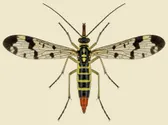
Panorpa communis has much more heavily marked wings, with broad dark tips and central spots that merge into a near-continuous band, while Panorpa germanica's wings are only lightly spotted.
Questions
Is the German scorpionfly dangerous to people?
Harmless despite its scorpion-like tail tip.
When can you see the German scorpionfly?
The German scorpionfly can be seen from April to September, by day.
Plate retouched from a photo by Stephan Sprinz, CC BY 4.0, Wikimedia Commons Licence
Report a mistake in this entry
Scorpionflies›Common scorpionflies›Panorpa
Last updated 2026-09-26. Every entry is checked against published sources.