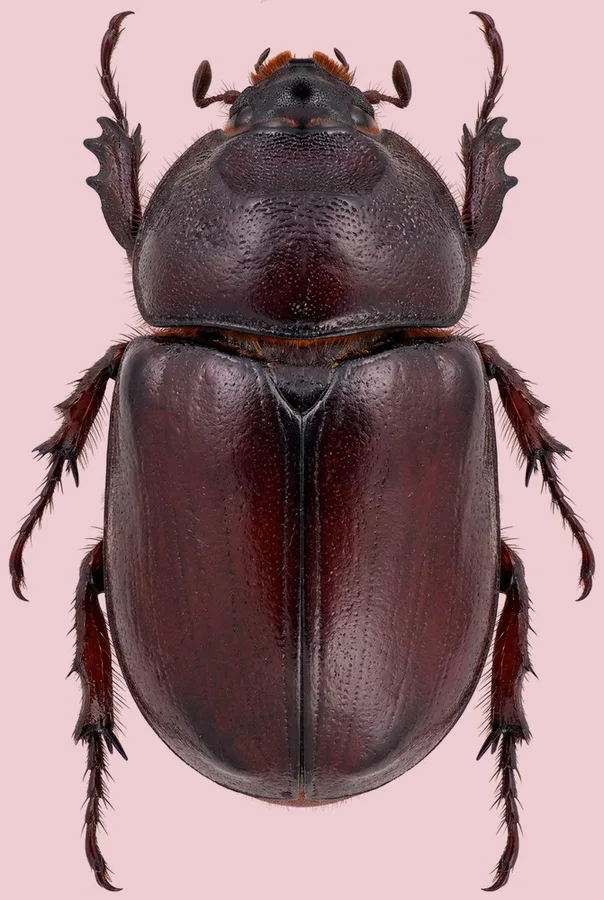
European rhinoceros beetle
Adult rhinoceros beetles never eat at all; they live entirely off fat reserves built up over several years as a larva inside rotting wood.
| Where | Old broadleaf woodland and orchards |
|---|---|
| Size | 20 to 42 mm long |
| When | April to August |
The European rhinoceros beetle is a large, glossy reddish brown beetle with long red hairs on its underside and legs. Males carry a long, curved horn on the head, which females lack.
Larvae live for several years inside rotting wood, compost heaps and old tree stumps, feeding on the decaying material, while the short lived adults do not feed at all and are most active after dark.
Traits
Habitat
Woodland
Colour
Brown, Red
Active
Night
To people
Harmless; despite its size and horn, it does not bite or sting people.
Activity through the year
Often confused with
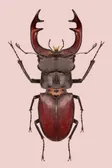
The stag beetle has large branched mandibles instead of a horn and can grow larger overall, up to about 75 mm long, compared with the rhinoceros beetle's smooth curved horn and smaller size.
Questions
Is the European rhinoceros beetle dangerous to people?
Harmless; despite its size and horn, it does not bite or sting people.
When can you see the European rhinoceros beetle?
The European rhinoceros beetle can be seen from April to August, at night.
Plate retouched from a photo by Magnefl, CC BY‑SA 4.0, Wikimedia Commons Licence
The plate on this page is shared under the same licence as its source, CC BY-SA.
Report a mistake in this entry
Last updated 2026-09-26. Every entry is checked against published sources.