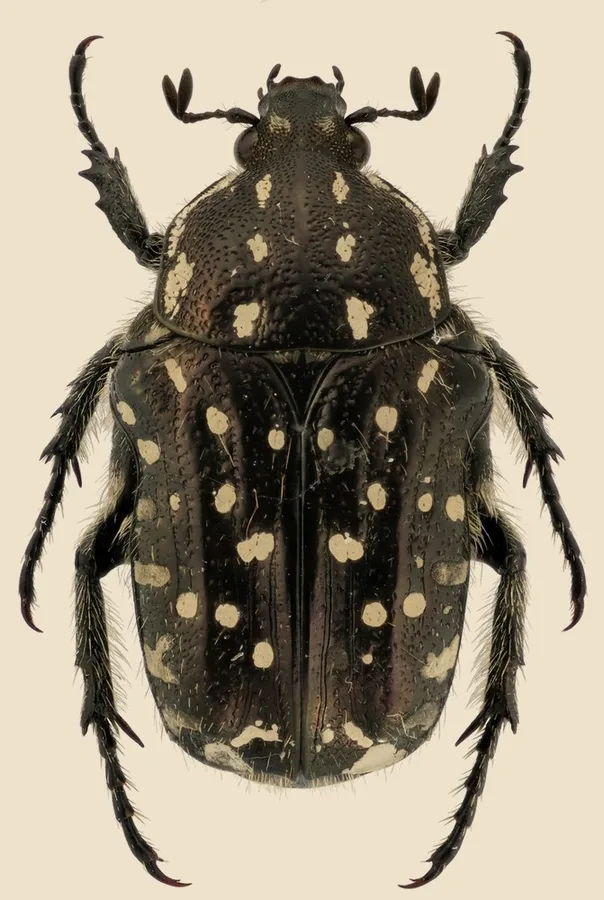
Mediterranean spotted chafer
Adult beetles feed on flower petals and pollen, favoring pale-colored blooms, which can make them a minor pest of orchard and garden flowers.
| Where | Flowering meadows, orchards and gardens |
|---|---|
| Size | 8 to 12 mm body length |
| When | April to August |
The Mediterranean spotted chafer is a small black beetle with a bronze sheen, patterned with irregular white spots across the pronotum and wing cases. Adults are often seen resting head-down inside open flowers.
Adults feed on pollen and flower petals with a preference for pale-colored blooms, a habit that can make them a minor pest where they gather in numbers. Larvae develop in soil, feeding on dung, rotten wood and leaf litter until the following spring.
Traits
Habitat
Grassland
Colour
Black, White
Active
Day
To people
Often seen inside open flowers feeding on pollen; it does not bite or sting people.
Activity through the year
Often confused with
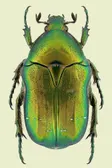
Distinctly larger at about 15 to 21 mm body length, and uniformly metallic green rather than black with irregular white spots.
Questions
Is the Mediterranean spotted chafer dangerous to people?
Often seen inside open flowers feeding on pollen; it does not bite or sting people.
When can you see the Mediterranean spotted chafer?
The Mediterranean spotted chafer can be seen from April to August, by day.
Plate retouched from a museum specimen photo by Villu Soon, University of Tartu, Natural History Museum and Botanical Garden, CC BY 4.0, GBIF Licence
Report a mistake in this entry
Last updated 2026-09-26. Every entry is checked against published sources.