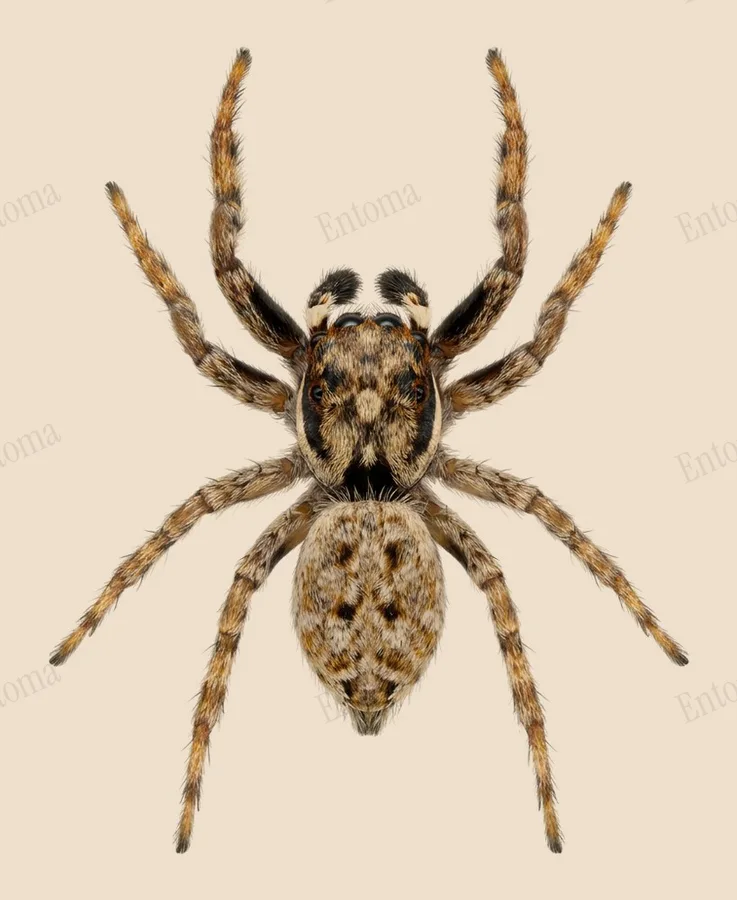
Half-edged wall jumping spider
This spider hunts entirely by sight and never spins a web to catch prey, instead stalking insects across sunlit walls of buildings and citrus groves.
| Where | Sunny walls, gardens and citrus groves |
|---|---|
| Size | Female 6.5 to 8.4 mm, male 5.1 to 7.4 mm body length |
| When | March to October |
The Half-edged wall jumping spider is a flattened, grayish-white jumping spider with a pale band along the sides of its head and a small white triangular mark at the centre. Its legs are light brown with darker rings, and the abdomen carries several bright V-shaped markings; males show black and white banded palps while those of females stay pale.
It lives on sunlit walls, garden fences and citrus groves across warm parts of Europe, hunting small insects and other spiders by sight rather than building a web. Adults are active during the day and can be found on buildings for most of the year in the warmest regions.
Traits
Habitat
Towns
Colour
Grey, White, Brown
Active
Day
To people
Not dangerous to people; it does not bite defensively and is usually seen resting motionless on sunlit walls.
Activity through the year
Often confused with
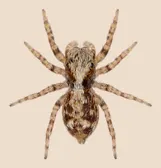
Considerably smaller, with males reaching only about 3 to 4 mm and females up to about 5 mm body length, against the Half-edged wall jumping spider's 5.1 to 8.4 mm.
Questions
Is the Half-edged wall jumping spider dangerous to people?
Not dangerous to people; it does not bite defensively and is usually seen resting motionless on sunlit walls.
When can you see the Half-edged wall jumping spider?
The Half-edged wall jumping spider can be seen from March to October, by day.
Plate retouched from a photo by Diego González Dopico, CC BY 4.0, iNaturalist Licence
Report a mistake in this entry
Spiders›Jumping spiders›Menemerus
Last updated 2026-09-27. Every entry is checked against published sources.