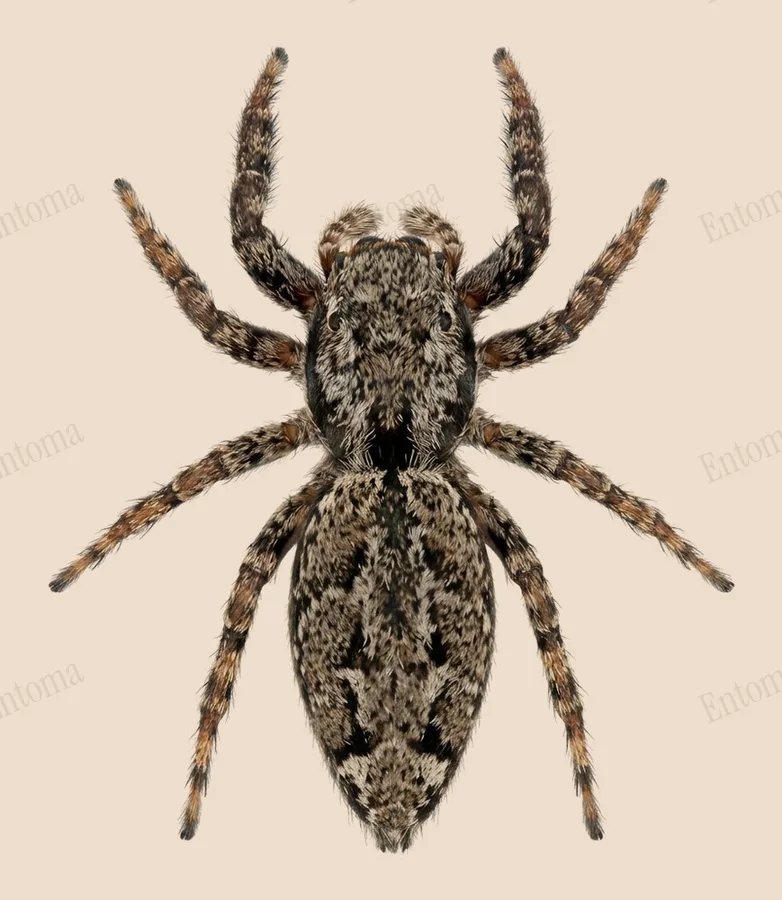
Fencepost jumping spider
Females of this large jumping spider carry a broad orange band beneath their eyes that males never develop, an easy way to tell the sexes apart.
| Where | Tree bark, fences and garden walls |
|---|---|
| Size | Female 7.5 to 14 mm, male 6 to 8.1 mm body length |
| When | March to September |
The Fencepost jumping spider is one of the largest jumping spiders in Europe, with a flattened, elongated body suited to hiding in narrow bark crevices. Its grey brown to dark brown colouring is broken by lighter chevron like bands, and mature females show a broad orange stripe beneath the front eyes that males lack.
It naturally lives under the bark of conifers on moorland and heathland, but across much of its range it has taken to fence posts, tree trunks and house walls in gardens and orchards. It sits motionless during the day, relying on excellent eyesight to ambush passing insects.
Traits
Habitat
Woodland
Colour
Brown, Grey
Active
Day
To people
Not dangerous to people; it never bites defensively and simply retreats into a bark crevice when disturbed.
Activity through the year
Often confused with
Similarly built and patterned, but lives among reed beds in wetlands rather than on bark, fence posts and walls.
Questions
Is the Fencepost jumping spider dangerous to people?
Not dangerous to people; it never bites defensively and simply retreats into a bark crevice when disturbed.
When can you see the Fencepost jumping spider?
The Fencepost jumping spider can be seen from March to September, by day.
Plate retouched from a photo by delilah88, CC BY 4.0, iNaturalist Licence
Report a mistake in this entry
Spiders›Jumping spiders›Marpissa
Last updated 2026-09-27. Every entry is checked against published sources.