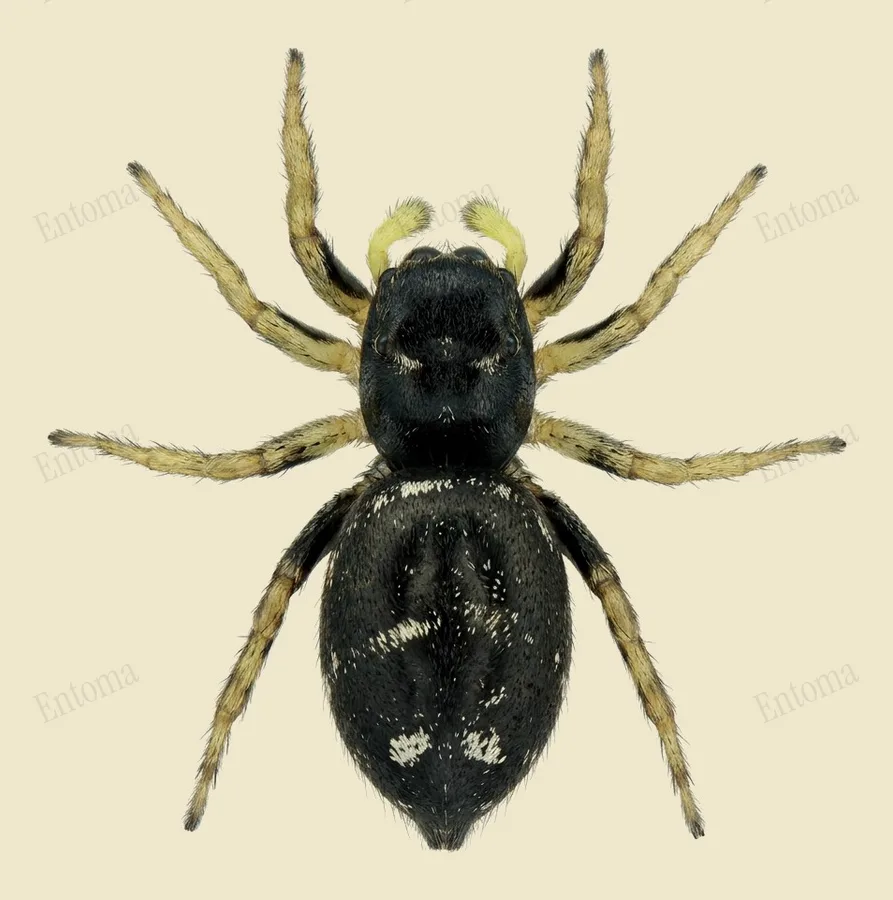
Copper sun jumper
Despite its shiny black, metallic body, this jumping spider hunts by sight alone, stalking prey across sunlit leaf litter rather than spinning any kind of web.
| Where | Meadows, forest edges and coastal cliffs |
|---|---|
| Size | Female 4.6 to 5.8 mm, male 3.6 to 4 mm body length |
| When | March to September |
The body is black with a shiny metallic sheen and scattered white hairs, including a pale line behind the eyes and white spots around the edge of the abdomen. Legs are light yellow with black stripes running their length, though a few individuals have uniformly dark legs.
It hunts on sunlit vegetation in damp meadows, forest edges and even coastal shingle, chasing down small insects instead of building a web. Most adults are seen in late spring and early summer, sheltering in a silk cell under a stone or in leaf litter overnight.
Traits
Habitat
Grassland
Colour
Black, Metallic, Yellow
Active
Day and night
To people
This jumping spider is not dangerous to people and will simply jump away if approached.
Activity through the year
Often confused with
Legs are plain golden yellow without stripes, unlike the yellow legs marked with black longitudinal stripes seen in the copper sun jumper.
Questions
Is the Copper sun jumper dangerous to people?
This jumping spider is not dangerous to people and will simply jump away if approached.
When can you see the Copper sun jumper?
The Copper sun jumper can be seen from March to September, by day and at night.
Plate retouched from a photo by tobiasschnberg, CC0, iNaturalist Licence
Report a mistake in this entry
Spiders›Jumping spiders›Heliophanus
Last updated 2026-09-27. Every entry is checked against published sources.