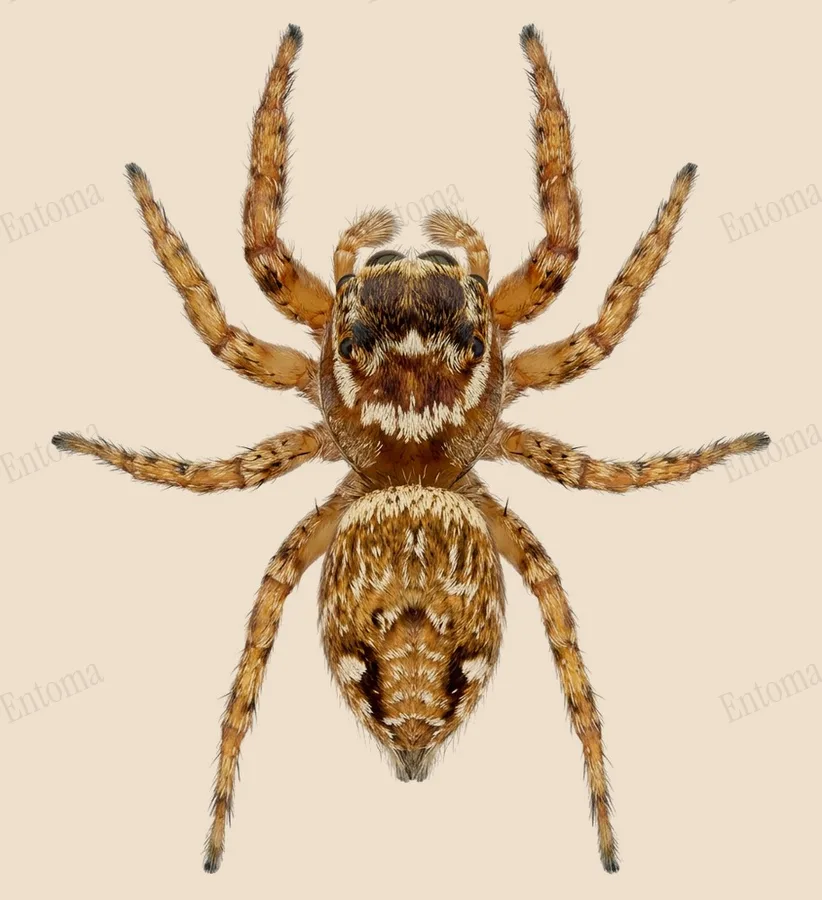
Mediterranean white-banded spider
Males carry a broad white hair band curving from the eyes to the back of the head, a bold mark rare among Mediterranean jumping spiders of similar size.
| Where | Mediterranean shrubland, southern Europe |
|---|---|
| Size | Female 5.5 to 7.4 mm, male 5.1 to 6.3 mm body length |
| When | April to October |
This small jumping spider is named for the broad white or yellowish band that sweeps around the male's head and a smaller band at the front of the abdomen; females show a similar head pattern with a darker, net patterned abdomen.
It lives mainly in the bush layer of warm shrubland, more rarely on the ground or in trees, hunting small insects by sight from lowland up to about 1500 metres.
Traits
Habitat
Heath
Colour
Black, White, Brown
Active
Day
To people
A small jumping spider with no documented bite to people; it poses no risk and hunts by sight among shrubs in the warmer parts of its range.
Activity through the year
Often confused with
Males show a narrower white arched stripe and a brownish yellow face plate rather than the broad band sweeping from the eyes to the back of the head seen in Evarcha jucunda, and females carry several curved white stripes across the rear of the abdomen instead of a single band.
Questions
Is the Mediterranean white-banded spider dangerous to people?
A small jumping spider with no documented bite to people; it poses no risk and hunts by sight among shrubs in the warmer parts of its range.
When can you see the Mediterranean white-banded spider?
The Mediterranean white-banded spider can be seen from April to October, by day.
Plate retouched from a photo by Doruk Ege Aksu, CC BY 4.0, iNaturalist Licence
Report a mistake in this entry
Spiders›Jumping spiders›Evarcha
Last updated 2026-09-27. Every entry is checked against published sources.