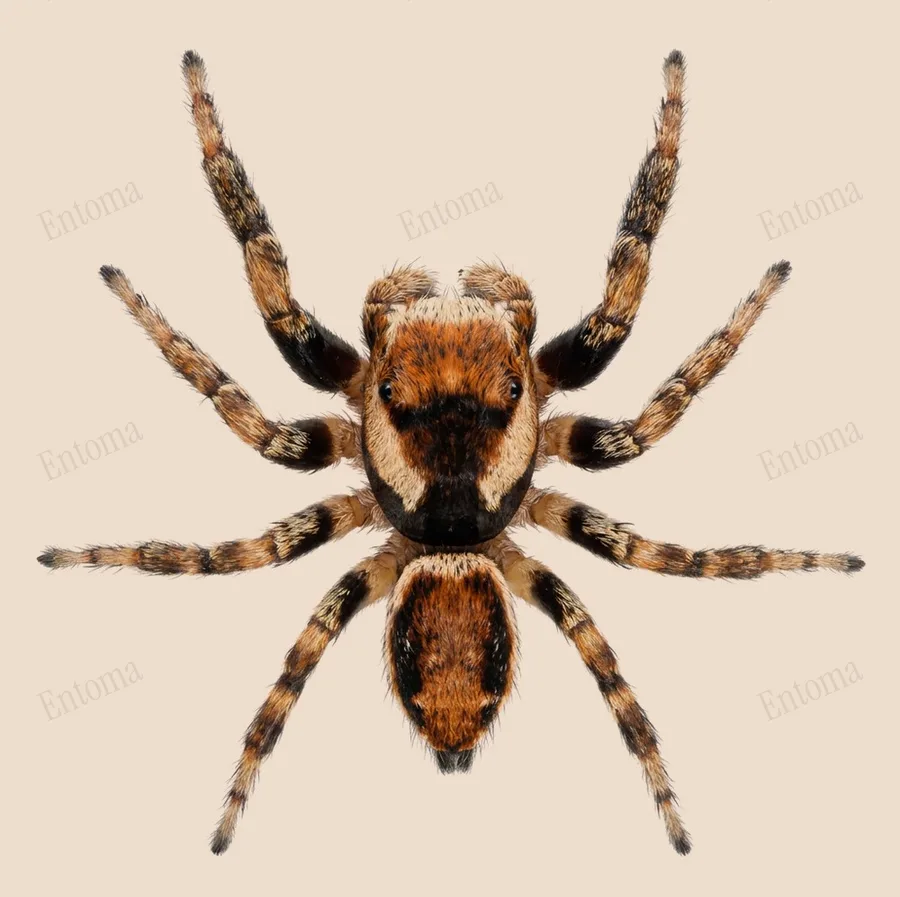
Woodland jumping spider
This jumping spider sees in far sharper detail than its pinhead size suggests, using its front eyes to judge distance before leaping onto prey it has spotted.
| Where | Sunny forest edges and grassy clearings |
|---|---|
| Size | Female 5 to 7.7 mm, male 4.3 to 5.9 mm body length |
| When | April to September |
Males have a black brown body broken by two pale stripes and an arc shaped patch of brown hairs on the abdomen, while females are more uniformly covered in brown hairs with paler sides. Both sexes have the large forward facing eyes typical of jumping spiders.
It hunts by day on sunlit forest edges, grass and shrubs, stalking prey visually before pouncing rather than relying on a web to catch food. It shelters overnight and during poor weather in a silk cell folded from a leaf or spun between stems.
Traits
Habitat
Grassland
Colour
Brown, Black, White
Active
Day
To people
This small jumping spider is not dangerous to people and shows no interest in biting, relying on its eyesight to hunt insects instead.
Activity through the year
Often confused with
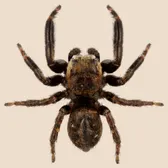
Males show noticeably longer white hairs on the face than the woodland jumping spider, whose facial hairs are shorter and less obvious.
Questions
Is the Woodland jumping spider dangerous to people?
This small jumping spider is not dangerous to people and shows no interest in biting, relying on its eyesight to hunt insects instead.
When can you see the Woodland jumping spider?
The Woodland jumping spider can be seen from April to September, by day.
Plate retouched from a museum specimen photo by Staatliche Naturwissenschaftliche Sammlungen Bayerns, CC BY 4.0, GBIF Licence
Report a mistake in this entry
Spiders›Jumping spiders›Evarcha
Last updated 2026-09-27. Every entry is checked against published sources.