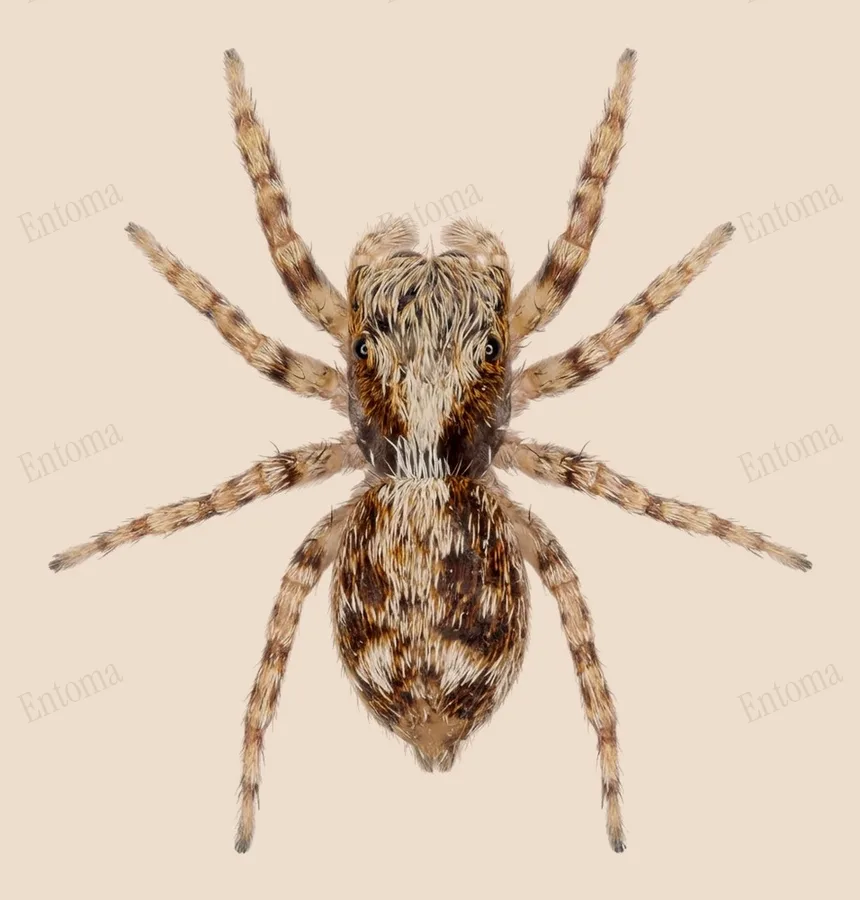
House jumping spider
Unlike most relatives, this jumping spider has become so tied to buildings that across parts of its range it now lives almost only indoors, even in winter.
| Where | In and on buildings |
|---|---|
| Size | Female 3.5 to 6 mm, male 2.6 to 5 mm body length |
| When | January to November |
The House jumping spider is small and brown, with white hairs across the head and a pale median line down the abdomen; orange hairs fringe the eyes, giving the face a warm tint under close view.
It lives on and inside buildings, walking over walls, window frames and ceilings in search of tiny prey such as booklice. Being sheltered indoors lets it stay active through the year rather than only in warmer months.
Traits
Habitat
Towns
Colour
Brown, White
Active
Day and night
To people
Not dangerous to people; this tiny jumping spider is commonly found indoors, feeding on booklice and other small insects rather than bothering residents.
Activity through the year
Often confused with
Pseudeuophrys erratica is much darker overall, with a blackish carapace and first legs almost entirely black, compared to the paler brown, white-haired House jumping spider whose legs are only lightly banded.
Questions
Is the House jumping spider dangerous to people?
Not dangerous to people; this tiny jumping spider is commonly found indoors, feeding on booklice and other small insects rather than bothering residents.
When can you see the House jumping spider?
The House jumping spider can be seen from January to November, by day and at night.
Plate retouched from a photo by Michael Knapp, CC BY 4.0, iNaturalist Licence
Report a mistake in this entry
Spiders›Jumping spiders›Pseudeuophrys
Last updated 2026-09-27. Every entry is checked against published sources.