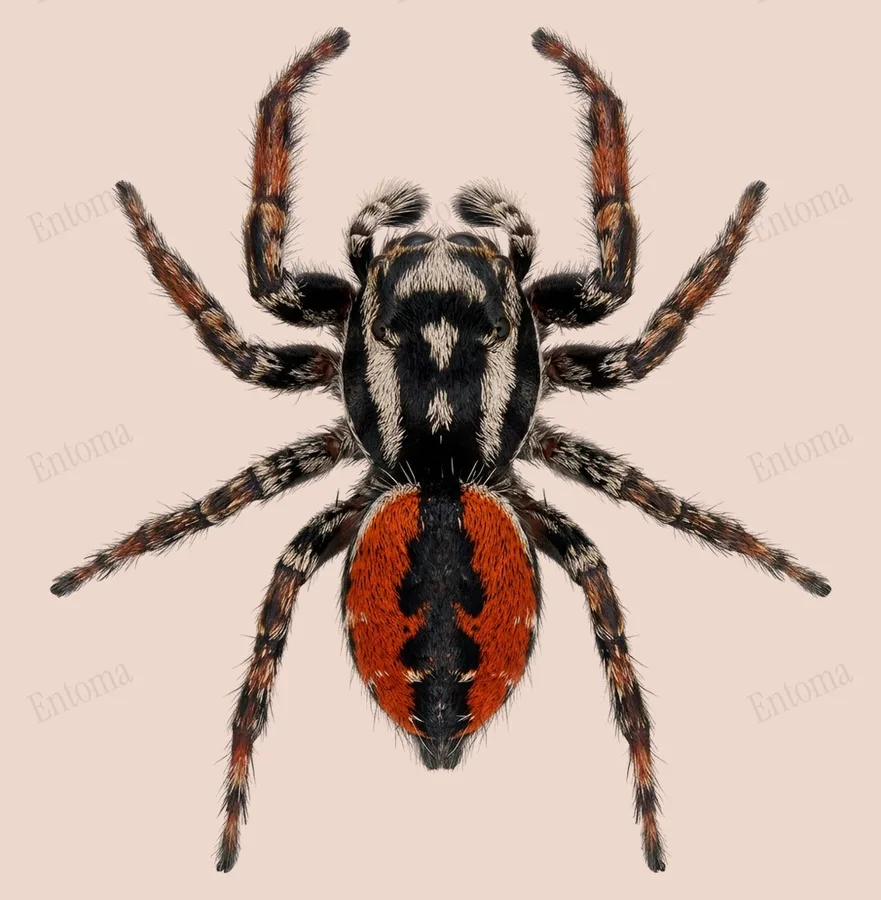
Red-bellied jumping spider
Only the mature males of this jumping spider turn bright red; females and young males stay black with white stripes their whole lives.
| Where | Warm rocky slopes and tree trunks |
|---|---|
| Size | Female 7.1 to 9.7 mm, male 5.4 to 9.5 mm body length |
| When | March to October |
The Red-bellied jumping spider shows striking sexual difference: adult males have a glaringly red abdomen with a black median stripe and a dark, white edged cephalothorax, while females and juvenile males stay black with two pale longitudinal stripes. The front legs of mature males are tipped with the same bright red.
It lives on sun baked rocks, dry sandy slopes and tree trunks across warm parts of Europe, hunting small insects by sight rather than building a web. It is active by day and needs strong warmth, reaching only the warmest microclimates at the northern edge of its range.
Traits
Habitat
Heath
Colour
Red, Black, White
Active
Day
To people
Not dangerous to people; it does not bite defensively and relies on jumping away to escape.
Activity through the year
Often confused with
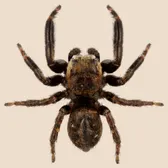
Females and young males of the Red-bellied jumping spider lack red and can resemble Evarcha arcuata, which is smaller (5.1 to 7 mm against 7.1 to 9.7 mm body length) and shows a dark median stripe on a uniformly brown body rather than the two parallel white stripes of the jumping spider's females.
Questions
Is the Red-bellied jumping spider dangerous to people?
Not dangerous to people; it does not bite defensively and relies on jumping away to escape.
When can you see the Red-bellied jumping spider?
The Red-bellied jumping spider can be seen from March to October, by day.
Plate retouched from a photo by Simone Luccini, CC BY 4.0, iNaturalist Licence
Report a mistake in this entry
Spiders›Jumping spiders›Philaeus
Last updated 2026-09-27. Every entry is checked against published sources.