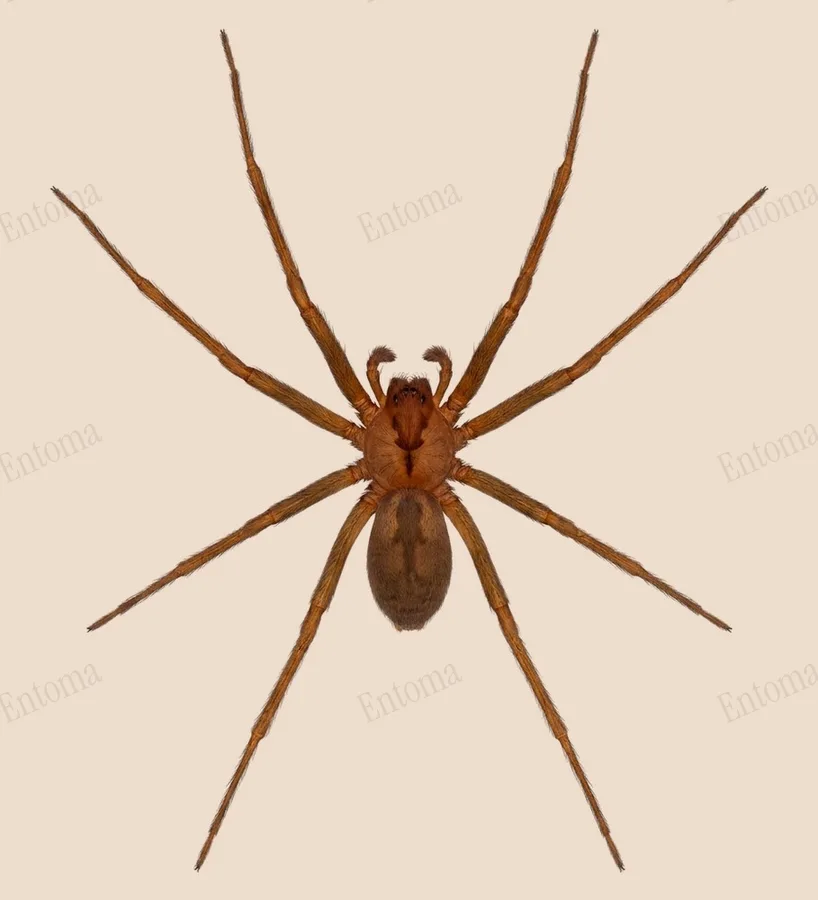
Mediterranean recluse
This recluse spider's bite is usually no worse than a mosquito's, yet its venom occasionally eats away skin slowly enough that a wound takes months to heal.
| Where | Buildings, cellars and dry rock crevices |
|---|---|
| Size | Both sexes about 7 to 7.5 mm body length |
| When | January to December |
This spider has a pale reddish yellow to orange brown body with long, thin legs and, unlike most spiders, only six eyes arranged in three widely spaced pairs rather than eight. There is no bold pattern, just a fairly uniform, slightly glossy body.
It shelters by day in dry cracks, cellars, attics and other undisturbed corners of buildings, coming out to hunt cockroaches and silverfish. Populations have slowly spread beyond their original Mediterranean range as the spider travels with stored goods and luggage.
Traits
Habitat
Towns
Colour
Brown, Orange
Active
Day and night
To people
Take care
Bites are uncommon and usually cause only local redness and itching that heal without treatment, though rare cases have led to a slow healing skin sore; wash any bite and seek medical care if pain, swelling or blistering spreads.
Activity through the year
Often confused with
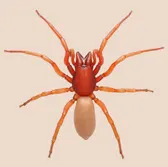
Has six eyes bunched tightly together rather than in three widely spaced pairs, a glossy red orange front half against a plain pale abdomen, and much larger jaws.
Questions
Is the Mediterranean recluse dangerous to people?
Take care. Bites are uncommon and usually cause only local redness and itching that heal without treatment, though rare cases have led to a slow healing skin sore; wash any bite and seek medical care if pain, swelling or blistering spreads.
When can you see the Mediterranean recluse?
The Mediterranean recluse can be seen from January to December, by day and at night.
Plate retouched from a photo by Charlotte Kirchner, CC BY 4.0, iNaturalist Licence
Report a mistake in this entry
Spiders›Recluse spiders›Loxosceles
Last updated 2026-09-27. Every entry is checked against published sources.