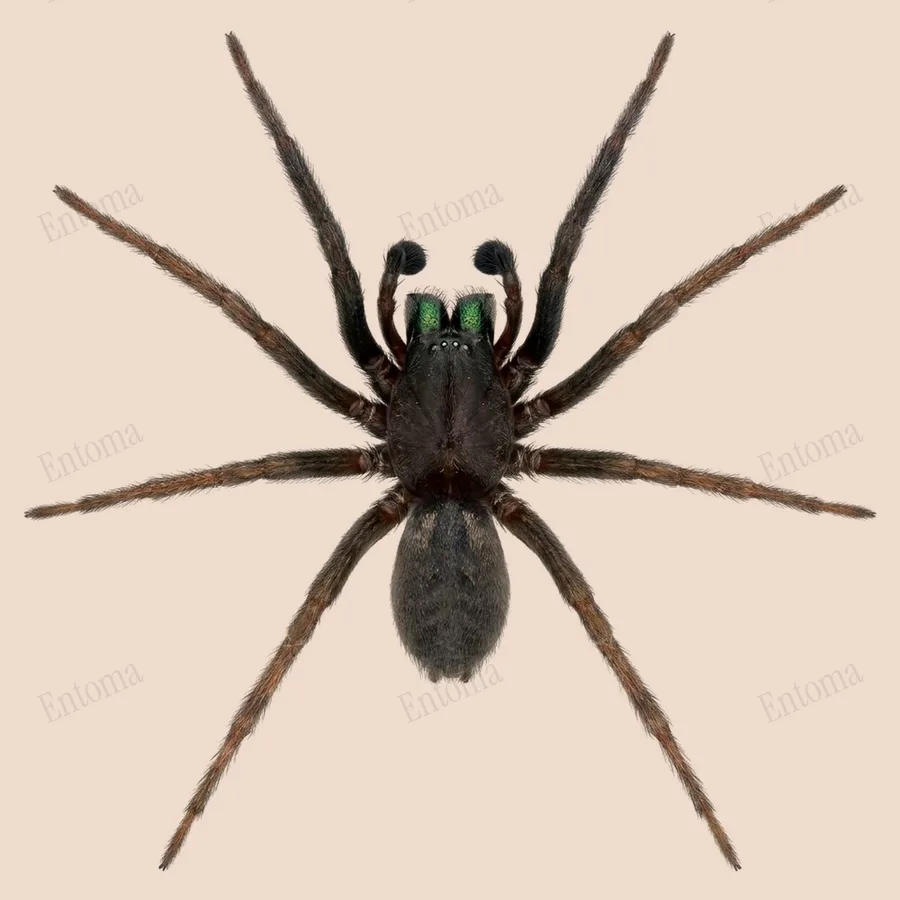
Tube-dwelling spider
Its fangs shine an iridescent bottle green, among the few spiders in its range with jaws long and strong enough to break human skin if handled roughly.
| Where | Cracks in old walls |
|---|---|
| Size | Female 14 to 22 mm, male 10 to 15 mm body length |
| When | March to December |
The Tube-dwelling spider is uniformly black except for its chelicerae, which flash a metallic green sheen, and is among the largest spiders found in its range, sheltering in silk-lined tunnels tucked into wall crevices.
Six or more trigger lines radiate from the tunnel entrance, and the spider rushes out the instant one twitches, seizing moths, woodlice or other insects that touch them. It hunts mainly after dark, retreating into the tunnel by day.
Traits
Habitat
Towns
Colour
Black, Green
Active
Night
To people
Mild
Can bite if handled or if a finger is pushed into its silk-lined retreat; the bite is painful, compared to a bee sting or a sharp injection, but has no lasting effects. Wash the bite site; medical care is rarely needed.
Activity through the year
Often confused with
Segestria senoculata is smaller, up to about 10 mm body length, with a grey abdomen marked by a row of black spots, unlike the uniformly black body and green-flashing fangs of the Tube-dwelling spider.
Questions
Is the Tube-dwelling spider dangerous to people?
Mild. Can bite if handled or if a finger is pushed into its silk-lined retreat; the bite is painful, compared to a bee sting or a sharp injection, but has no lasting effects. Wash the bite site; medical care is rarely needed.
When can you see the Tube-dwelling spider?
The Tube-dwelling spider can be seen from March to December, at night.
Plate retouched from a photo by Luis Martin Stivanello, CC BY 4.0, iNaturalist Licence
Report a mistake in this entry
Spiders›Tube-dwelling spiders›Segestria
Last updated 2026-09-27. Every entry is checked against published sources.