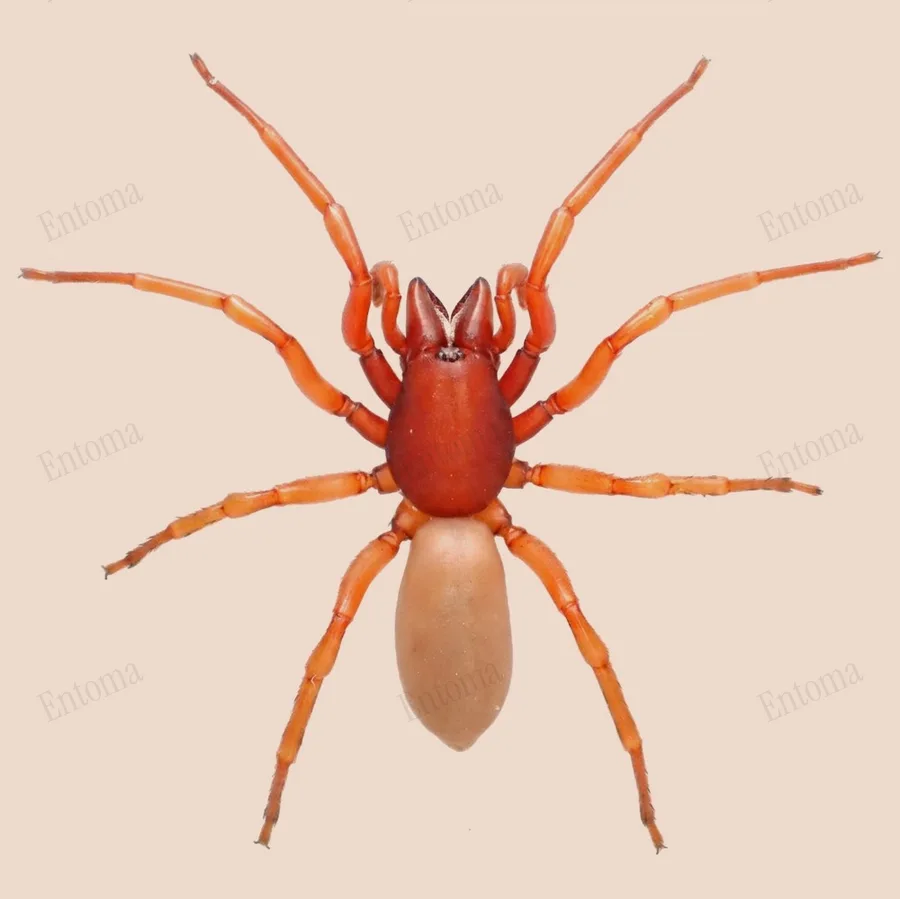
Woodlouse spider
Its oversized fangs are shaped to flip and pierce armored pillbugs and sowbugs from underneath, prey that most other spiders cannot handle.
| Where | Gardens, cellars and compost heaps |
|---|---|
| Size | Female 11 to 15 mm, male 9 to 10 mm body length |
| When | January to November |
The woodlouse spider has a glossy orange red to mahogany head and legs and a plain, unmarked cream or buff abdomen, with unusually long fangs that fold beneath its jaws like a pair of switchblades. It builds no web, instead hunting on foot after dark.
It shelters by day under logs, stones, mulch and paving slabs, and often turns up in compost heaps, cellars and garages. Introduced from the Mediterranean, it is now established across the United States and Canada wherever woodlice and other ground-dwelling invertebrates are common.
Traits
Habitat
Garden
Colour
Orange, Brown, White
Active
Night
To people
Mild
Bites are known but mild, causing a sharp pinprick with brief local redness, swelling and itching that fade within a few hours; there is no lasting harm.
Activity through the year
Often confused with
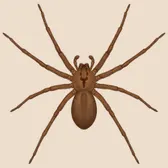
Often mistaken for it because of its long fangs and plain body, but the woodlouse spider has a glossy orange red head and legs with an unmarked cream abdomen, lacking the brown recluse's dark violin shaped mark.
Questions
Is the Woodlouse spider dangerous to people?
Mild. Bites are known but mild, causing a sharp pinprick with brief local redness, swelling and itching that fade within a few hours; there is no lasting harm.
When can you see the Woodlouse spider?
The Woodlouse spider can be seen from January to November, at night.
Plate retouched from a photo by Joss Carr, CC BY 4.0, iNaturalist Licence
Report a mistake in this entry
Spiders›Woodlouse hunters›Dysdera
Last updated 2026-09-27. Every entry is checked against published sources.