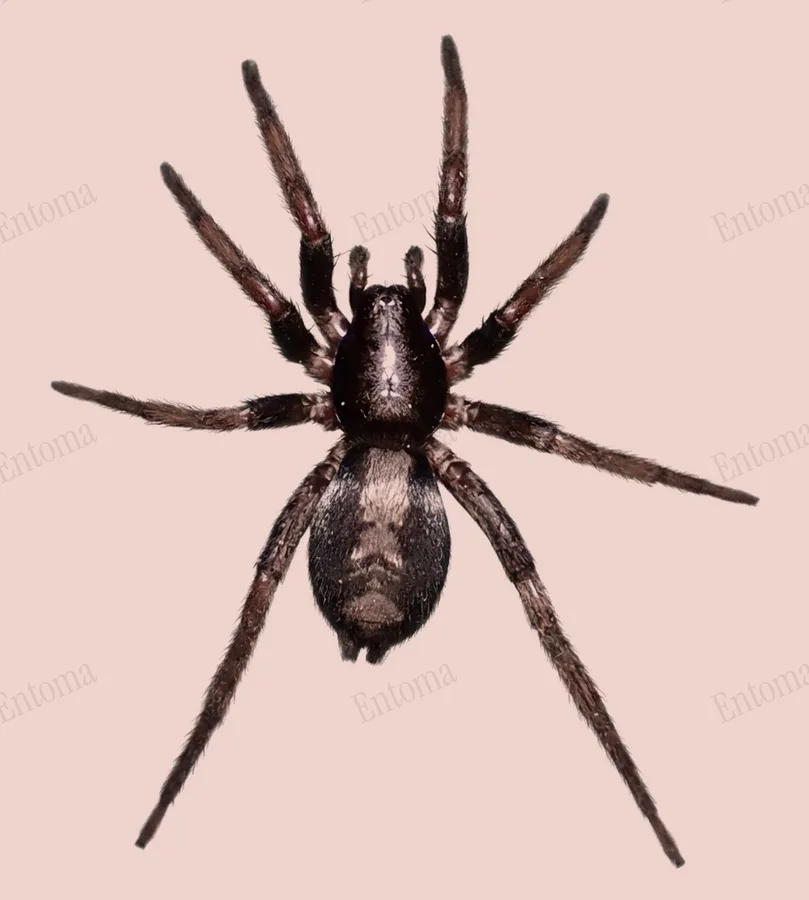
Eastern parson spider
Its pale abdominal stripe recalls an old clerical collar, and this fast-moving ground hunter can outrun most spiders when it needs to escape.
| Where | Woodlands east of the Rocky Mountains |
|---|---|
| Size | Female 7 to 13 mm, male 5 to 6 mm body length |
| When | March to October |
The eastern parson spider is dark, almost black, with fine grey hairs on the abdomen and a broad white or pinkish stripe running down its back that gives the species its name. Males are smaller and slimmer than females.
It hunts at night on the ground and spends the day in a silk retreat under bark, stones or leaf litter, moving in a rapid zigzag when disturbed. It is found in woodlands east of the Rocky Mountains and often wanders indoors in autumn.
Traits
Habitat
Woodland
Colour
Black, Grey, White
Active
Night
To people
Mild
Bites are usually mild, causing little more than brief redness or itching, though rare allergic reactions with swelling have been reported; the bite is not considered dangerous.
Activity through the year
Often confused with
Nearly identical in color and pattern to the eastern parson spider; the two are reliably told apart only by examining the male's genitalia, since markings and size overlap completely.
Questions
Is the Eastern parson spider dangerous to people?
Mild. Bites are usually mild, causing little more than brief redness or itching, though rare allergic reactions with swelling have been reported; the bite is not considered dangerous.
When can you see the Eastern parson spider?
The Eastern parson spider can be seen from March to October, at night.
Plate retouched from a photo by Sue Carnahan, CC BY 4.0, iNaturalist Licence
Report a mistake in this entry
Spiders›Ground spiders›Herpyllus
Last updated 2026-09-27. Every entry is checked against published sources.