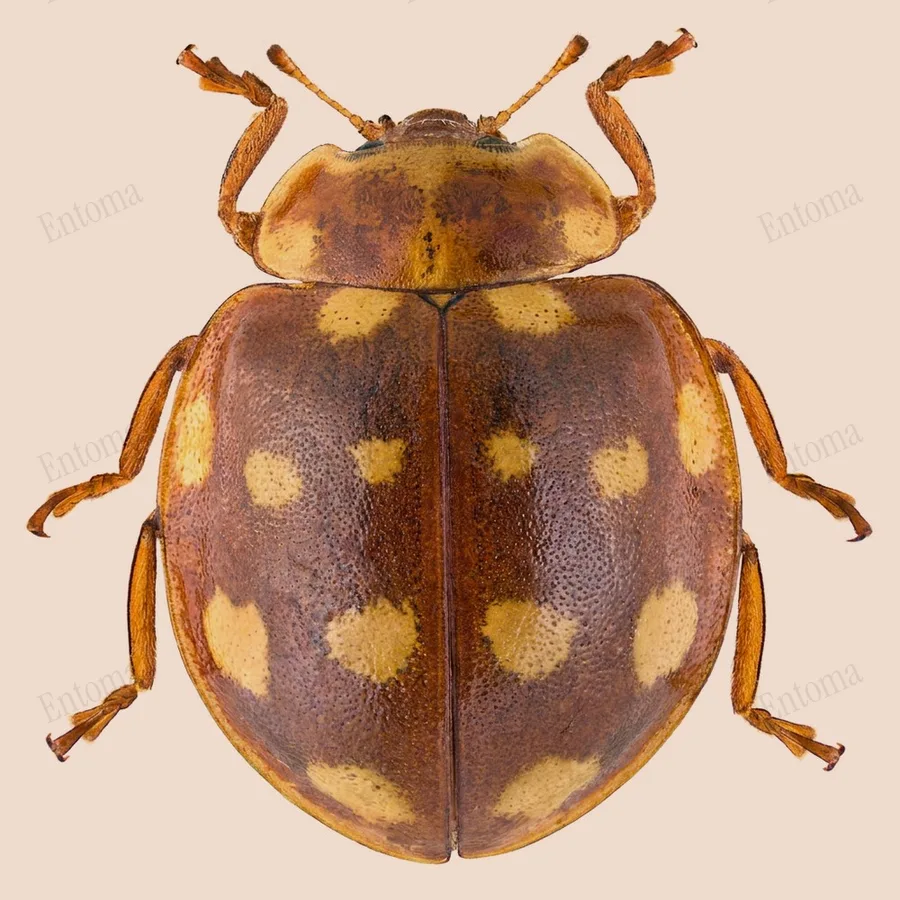
Cream-spotted ladybird
Cream-spotted ladybirds gather in tight clusters under tree bark to overwinter together, then scatter in spring to hunt aphids alone.
| Where | Hedgerows and deciduous trees |
|---|---|
| Size | 4 to 5 mm long |
| When | March to October |
The wing cases are a warm maroon-brown patterned with fourteen pale cream spots, and the body is oval and only weakly domed. It measures roughly 4 to 5 mm and turns up on hedgerow shrubs and deciduous trees rather than out in open grassland.
Adults hunt aphids, psyllids and other soft-bodied insects through summer, then gather in sheltered groups under bark or in leaf litter to overwinter before mating again the following spring.
Traits
Habitat
Woodland
Colour
Brown, White
Active
Day
To people
Harmless; beneficial aphid predator
Activity through the year
Often confused with
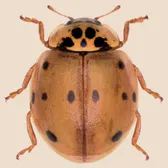
The 10-spot ladybird overlaps in size and can also appear plain brown, but it lacks the cream-spotted ladybird's fixed pattern of fourteen pale spots and instead varies wildly between red, chequered and near-black forms.
Questions
Is the Cream-spotted ladybird dangerous to people?
Harmless; beneficial aphid predator.
When can you see the Cream-spotted ladybird?
The Cream-spotted ladybird can be seen from March to October, by day.
Plate retouched from a photo by URSchmidt, CC BY‑SA 4.0, Wikimedia Commons Licence
The plate on this page is shared under the same licence as its source, CC BY-SA.
Report a mistake in this entry
Last updated 2026-09-26. Every entry is checked against published sources.