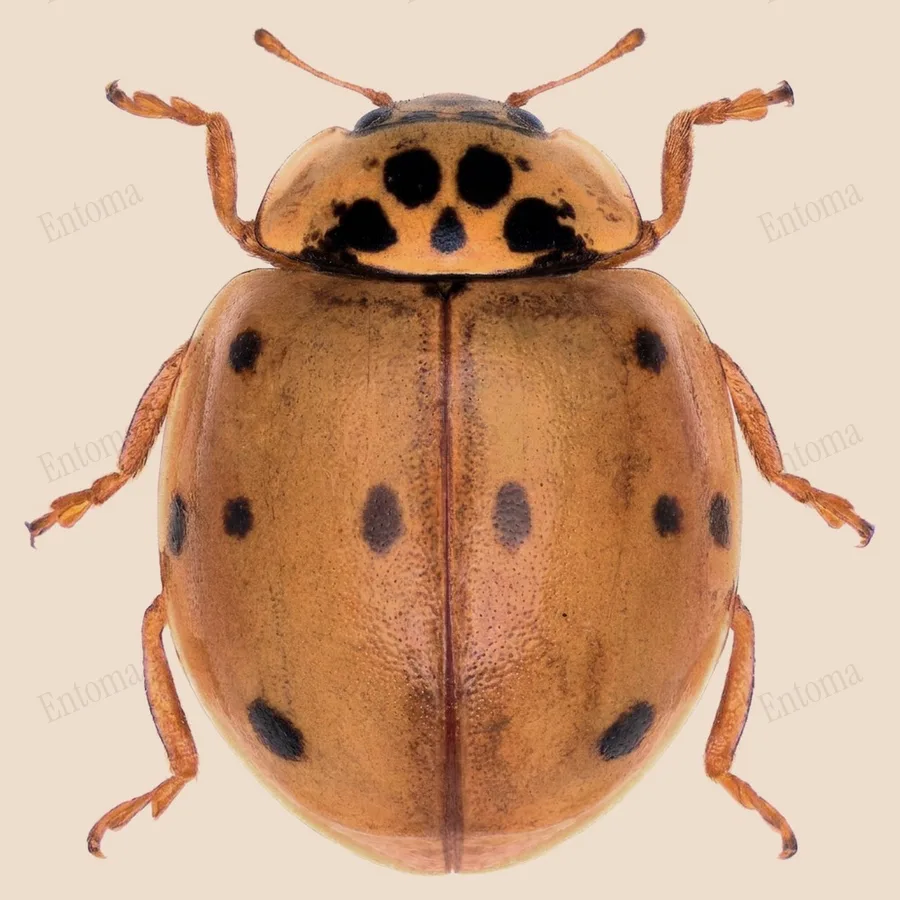
10-spot ladybird
Despite its name, this ladybird rarely settles on exactly ten spots, with wild individuals showing anywhere from zero to fifteen spots across three color forms.
| Where | Trees, hedgerows, gardens |
|---|---|
| Size | 3.5 to 4.5 mm long |
| When | March to October |
This small ladybird appears in typical orange or red forms with dark spots, a checkered buff form, and a dark melanic form, but the pale pronotum with five dark spots and plain brown legs stay consistent.
Adults and larvae both hunt aphids on trees, shrubs and garden plants, and adults overwinter in leaf litter or bark crevices.
Traits
Habitat
Garden
Colour
Orange, Black, Brown
Active
Day
To people
Harmless; adults and larvae eat garden aphids
Activity through the year
Often confused with
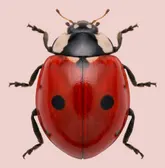
The 2-spot ladybird has black legs, while the 10-spot ladybird's legs are brown, a reliable difference even when their spot patterns overlap.
Questions
Is the 10-spot ladybird dangerous to people?
Harmless; adults and larvae eat garden aphids.
When can you see the 10-spot ladybird?
The 10-spot ladybird can be seen from March to October, by day.
Plate retouched from a photo by Udo Schmidt from Deutschland, CC BY‑SA 2.0, Wikimedia Commons Licence
The plate on this page is shared under the same licence as its source, CC BY-SA.
Report a mistake in this entry
Last updated 2026-09-26. Every entry is checked against published sources.