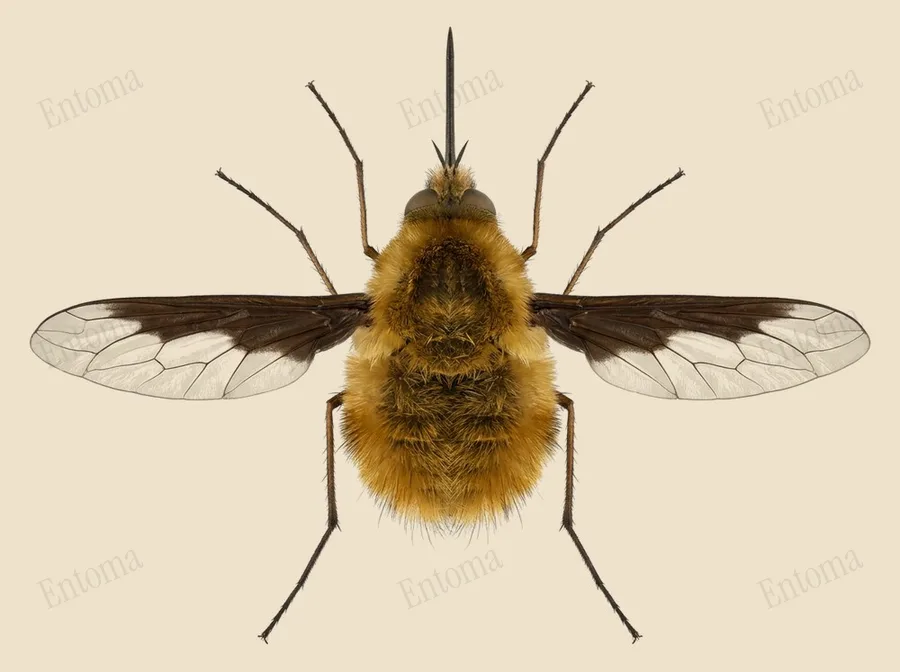
Greater bee fly
It hovers above the entrance of a solitary bee's burrow and flicks its eggs inside from mid-air, never landing or entering the nest itself.
| Where | Gardens, sunny banks, woodland edges |
|---|---|
| Size | 8 to 12 mm long |
| When | March to May |
It looks like a small, round, very furry bee, with a long rigid proboscis held stiffly forward, extremely thin dangling legs, and a dark band along the leading edge of each wing.
The larvae hatch inside solitary bee nests and feed on the bee grubs stored there, while the adults spend their short flight season hovering at spring flowers to drink nectar.
Traits
Habitat
Garden
Colour
Brown, Orange
Active
Day
To people
Harmless; cannot bite or sting despite resembling a bee
Activity through the year
Often confused with
The dotted bee fly has scattered dark spots across its wings and a darker, more chestnut-toned body, while the greater bee fly's wings are clear apart from one solid dark leading edge.
Questions
Is the Greater bee fly dangerous to people?
Harmless; cannot bite or sting despite resembling a bee.
When can you see the Greater bee fly?
The Greater bee fly can be seen from March to May, by day.
Plate retouched from a photo by gailhampshire from Cradley, Malvern, U.K, CC BY 2.0, Wikimedia Commons Licence
Report a mistake in this entry
Last updated 2026-09-26. Every entry is checked against published sources.