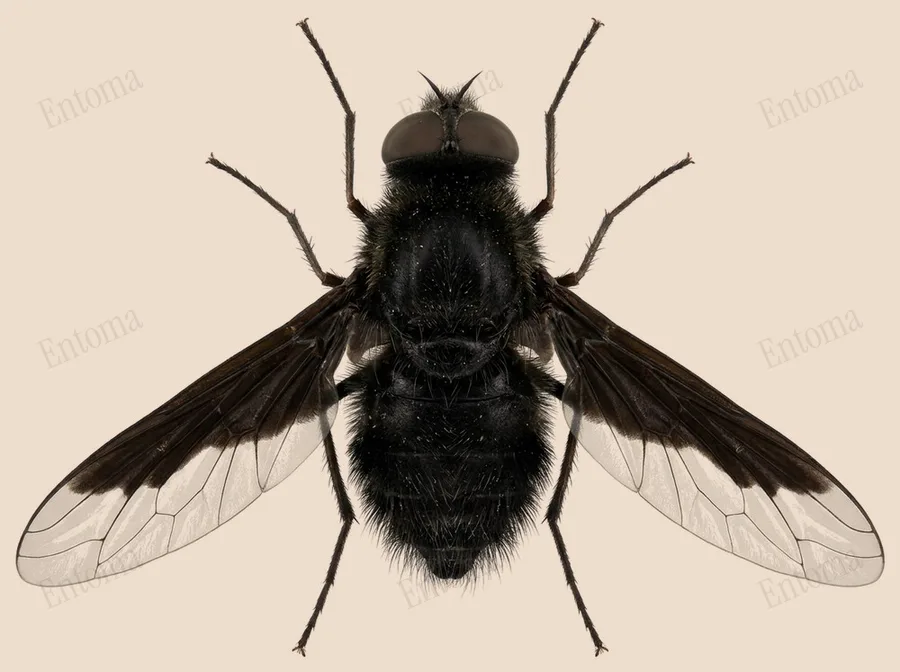
Black banded bee fly
Its larvae are hyperparasites, developing inside a parasitic fly or wasp grub that is itself living inside a moth caterpillar.
| Where | Flowery grassland and scrub edges |
|---|---|
| Size | 7 to 12 mm body length |
| When | May to July |
This bee fly has a dark brown, densely hairy body with paler hair along the sides of the abdomen, and wings divided by a sharp zigzag line into a dark area near the base and a clear area toward the tip. It is smaller and less bulky than many other bee flies.
Larvae are hyperparasitoids, developing inside the larvae of tachinid flies and ichneumonid wasps that themselves parasitize moth caterpillars, while adults feed on nectar and pollen from open flowers such as lavender and broom.
Traits
Habitat
Grassland
Colour
Brown, Black
Active
Day
To people
Harmless mimic of a small bee; it has no sting and does not bite people.
Activity through the year
Often confused with
A similar size at 6 to 12 mm, but its wing darkening covers a broader area without the sharp zigzag boundary seen in the black banded bee fly, giving it a more evenly dark-winged look.
Questions
Is the Black banded bee fly dangerous to people?
Harmless mimic of a small bee; it has no sting and does not bite people.
When can you see the Black banded bee fly?
The Black banded bee fly can be seen from May to July, by day.
Plate retouched from a photo by Andreas Eichler, CC BY‑SA 4.0, Wikimedia Commons Licence
The plate on this page is shared under the same licence as its source, CC BY-SA.
Report a mistake in this entry
Last updated 2026-09-26. Every entry is checked against published sources.