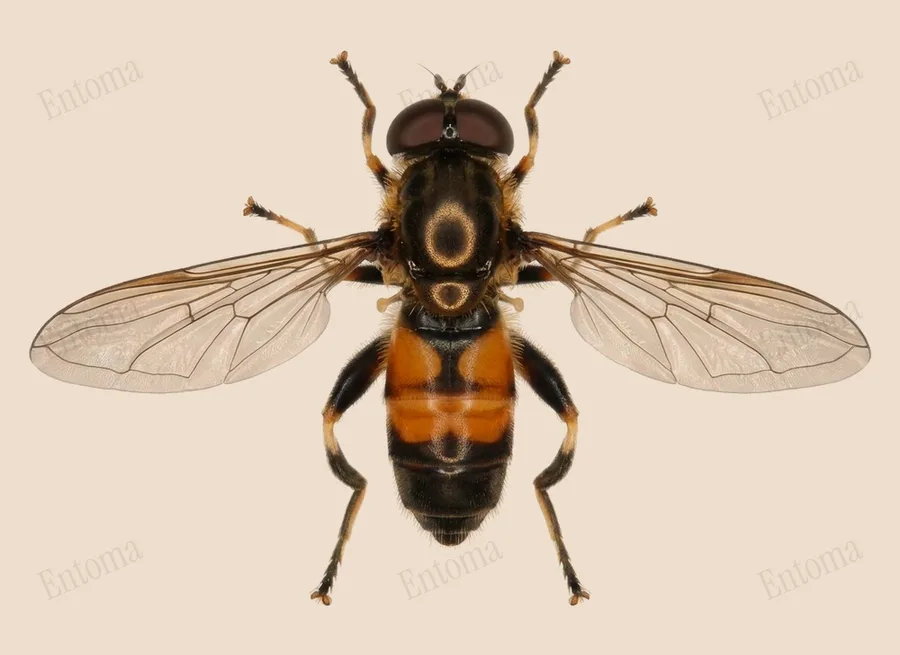
Orange-belted leafwalker
Its larvae develop in wet, rotting wood, while adults walk slowly and deliberately across leaves rather than darting like most hoverflies.
| Where | Woodland, hedgerows, and gardens |
|---|---|
| Size | 10 to 14 mm long |
| When | April to October |
This hoverfly has a greenish black thorax covered in long yellowish hairs and a dark abdomen crossed by an unbroken red or yellowish red patch, though it can be hidden under the folded wings at rest. Adults measure 10 to 14 mm long.
Larvae develop in wet, rotting wood and damp sawdust, and adults fly from April through September, most often seen walking slowly over low foliage in woodland rather than hovering.
Traits
Habitat
Woodland
Colour
Black, Orange
Active
Day
To people
Harmless to people.
Activity through the year
Often confused with
Xylota tarda has a similar wing length of 5.5 to 8.5 mm against segnis's 7 to 9.5 mm, but shows more extensive red on the abdomen and a clear, unshaded wing membrane.
Questions
Is the Orange-belted leafwalker dangerous to people?
Harmless to people.
When can you see the Orange-belted leafwalker?
The Orange-belted leafwalker can be seen from April to October, by day.
Plate retouched from a photo by Donald Hobern from Copenhagen, Denmark, CC BY 2.0, Wikimedia Commons Licence
Report a mistake in this entry
Last updated 2026-09-26. Every entry is checked against published sources.