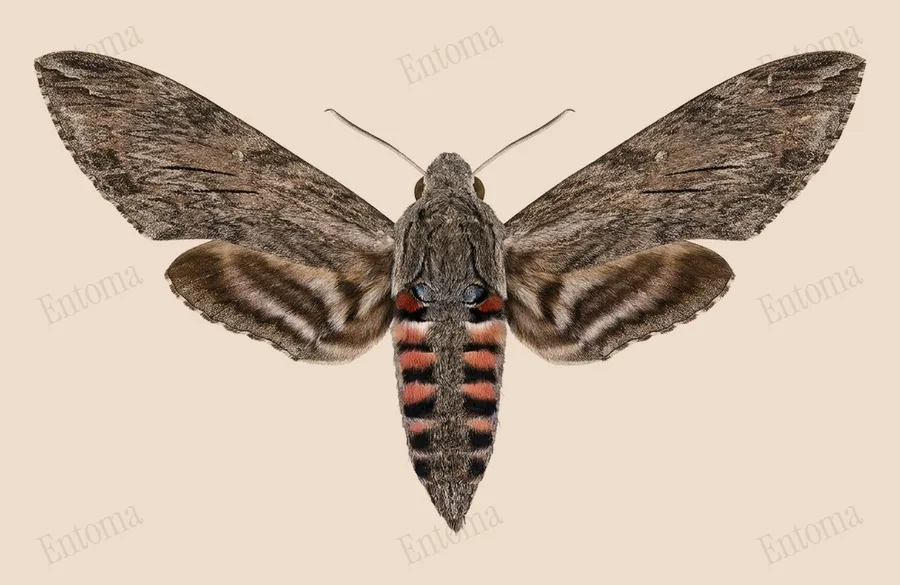
Convolvulus hawk-moth
Its proboscis can uncoil longer than its own body, letting this migrant hawk-moth drink nectar from deep, tubular flowers no other European moth can reach.
| Where | Gardens and coastal areas, seasonal migrant |
|---|---|
| Size | 80 to 120 mm wingspan |
| When | April to October |
The Convolvulus hawk-moth is a large, grey-brown moth with a pink and black striped abdomen visible when the hindwings are exposed. Its exceptionally long proboscis lets it hover and feed from tubular flowers such as tobacco plant and petunia.
It is a regular migrant to Europe from Africa and the Mediterranean, arriving mostly in late summer and autumn and unable to survive northern winters. Caterpillars, when present, feed on bindweed and other members of the Convolvulaceae family.
Traits
Habitat
Garden
Colour
Grey, Brown
Active
Night
To people
Attracted to light and scented flowers at night; poses no known risk to people.
Activity through the year
Often confused with
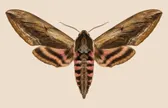
A similar 90 to 120 mm wingspan and pink and black striped abdomen, but with browner forewings marked by cream wavy lines, and it is a resident rather than a migrant.
Questions
Is the Convolvulus hawk-moth dangerous to people?
Attracted to light and scented flowers at night; poses no known risk to people.
When can you see the Convolvulus hawk-moth?
The Convolvulus hawk-moth can be seen from April to October, at night.
Plate retouched from a photo by Didier Descouens, CC BY‑SA 4.0, Wikimedia Commons Licence
The plate on this page is shared under the same licence as its source, CC BY-SA.
Report a mistake in this entry
Butterflies and moths›Hawk moths›Agrius
Last updated 2026-09-26. Every entry is checked against published sources.