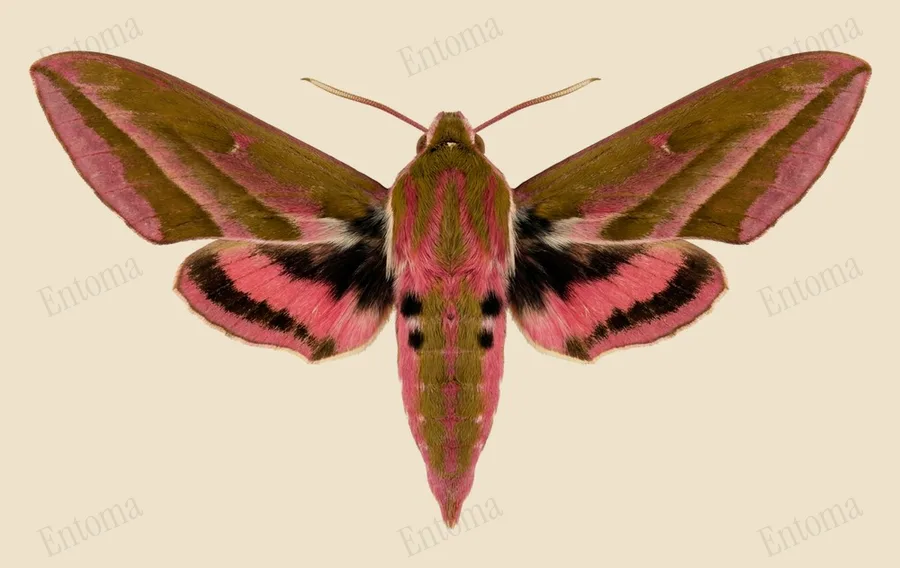
Elephant hawkmoth
Instead of landing on flowers, it hovers in place on fast-beating wings to drink nectar with a long tongue, much like a hummingbird.
| Where | Grassland, heathland, hedgerows, and gardens |
|---|---|
| Size | 45 to 70 mm wingspan |
| When | May to August |
The forewings are olive brown edged in pink, the hindwings are black shading into pink, and a thick pink stripe runs down the length of the body.
It flies at dusk and after dark, feeding on tubular flowers such as honeysuckle, and its caterpillars eat rosebay willowherb and bedstraws before pupating for winter.
Traits
Habitat
Garden
Colour
Green, Brown, Red
Active
Night
To people
Harmless
Activity through the year
Often confused with
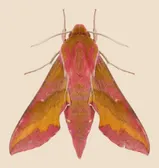
The small elephant hawk-moth is noticeably smaller and shows more yellow-green in its forewings, with less of the bold pink banding seen on the elephant hawkmoth.
Questions
Is the Elephant hawkmoth dangerous to people?
The Elephant hawkmoth is harmless to people.
When can you see the Elephant hawkmoth?
The Elephant hawkmoth can be seen from May to August, at night.
Plate retouched from a photo by Didier Descouens, CC BY‑SA 4.0, Wikimedia Commons Licence
The plate on this page is shared under the same licence as its source, CC BY-SA.
Report a mistake in this entry
Butterflies and moths›Hawk moths›Deilephila
Last updated 2026-09-26. Every entry is checked against published sources.