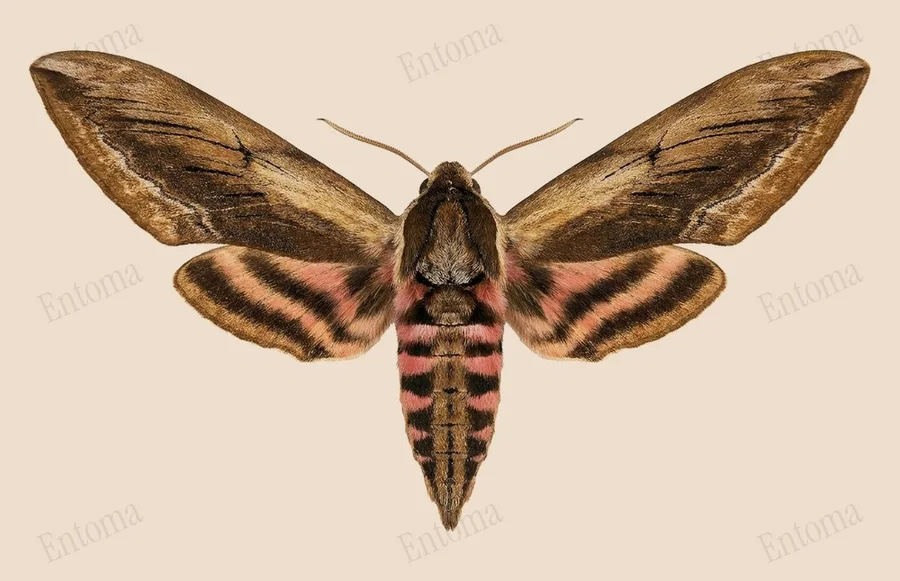
Privet hawkmoth
If disturbed, a male Privet hawkmoth can hiss loudly by rubbing scales and spines at its abdomen tip together, a startling sound from a seemingly silent moth.
| Where | Gardens, hedgerows and woodland edges |
|---|---|
| Size | 90 to 120 mm wingspan |
| When | May to August |
The Privet hawkmoth is one of the largest hawkmoths of western Europe, with long pointed dark brown forewings that fold to hide pink hindwings and a body banded in pink and black.
The single yearly generation flies at night from late spring into summer and comes readily to light, while the bright green caterpillar, marked with pale diagonal stripes and a curved tail horn, feeds on privet, lilac and ash.
Traits
Habitat
Garden
Colour
Brown, Red, Black
Active
Night
To people
Does not bite or sting; if handled, males may hiss by rubbing scales at the tip of the abdomen together.
Activity through the year
Often confused with
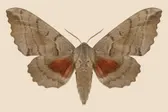
Smaller, with a wingspan of about 65 to 90 mm, scalloped grey-brown wings, and a habit of resting with the hindwings pushed forward of the forewings.
Questions
Is the Privet hawkmoth dangerous to people?
Does not bite or sting; if handled, males may hiss by rubbing scales at the tip of the abdomen together.
When can you see the Privet hawkmoth?
The Privet hawkmoth can be seen from May to August, at night.
Plate retouched from a photo by Didier Descouens, CC BY‑SA 4.0, Wikimedia Commons Licence
The plate on this page is shared under the same licence as its source, CC BY-SA.
Report a mistake in this entry
Butterflies and moths›Hawk moths›Sphinx
Last updated 2026-09-26. Every entry is checked against published sources.