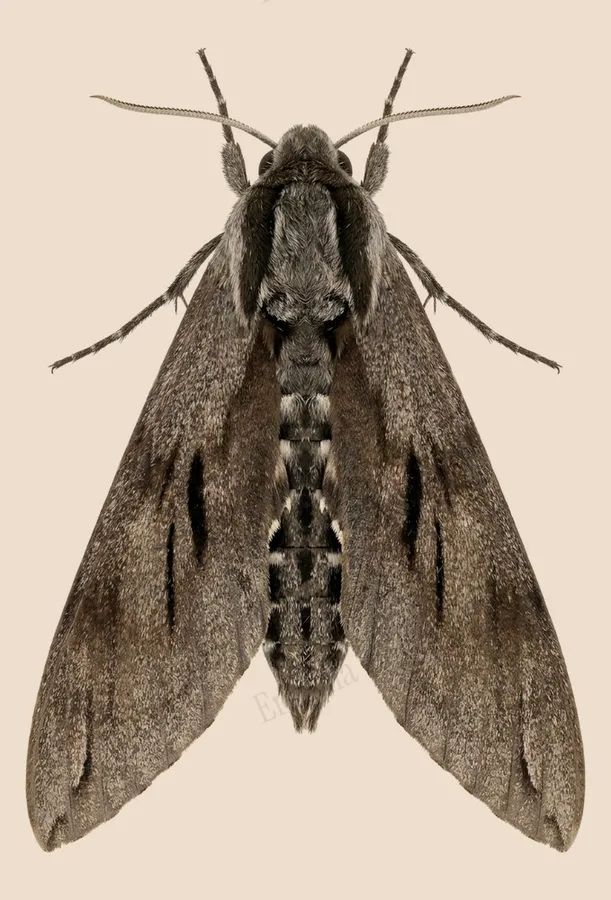
Pine hawk-moth
The pine hawkmoth's forewings carry three or four dark dashes and a chequered fringe, camouflage that matches the pine and spruce needles its caterpillars eat.
| Where | Coniferous woodland with Scots pine |
|---|---|
| Size | 65 to 80 mm wingspan |
| When | May to September |
The pine hawkmoth has long, narrow grey brown forewings marked with three or four dark dashes near the centre and a finely chequered fringe along the wing edge. The hindwings are plainer and mostly hidden at rest, in the manner typical of hawkmoths.
A single generation flies from May into September, mostly after dark, when adults visit flowers such as honeysuckle to feed. Caterpillars feed on the needles of Scots pine and other conifers such as Norway spruce, and the species turns up wherever mature pine trees grow.
Traits
Habitat
Woodland
Colour
Grey, Black
Active
Night
To people
Not harmful to people; it flies only at night and feeds on flowers such as honeysuckle.
Activity through the year
Often confused with
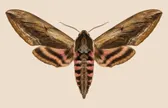
Much larger at 90 to 120 mm wingspan, with a pink and black striped body and hindwings, unlike the plainer grey pine hawkmoth.
Questions
Is the Pine hawk-moth dangerous to people?
Not harmful to people; it flies only at night and feeds on flowers such as honeysuckle.
When can you see the Pine hawk-moth?
The Pine hawk-moth can be seen from May to September, at night.
Plate retouched from a photo by Ben Sale from Stevenage, UK, CC BY 2.0, Wikimedia Commons Licence
Report a mistake in this entry
Butterflies and moths›Hawk moths›Sphinx
Last updated 2026-09-26. Every entry is checked against published sources.