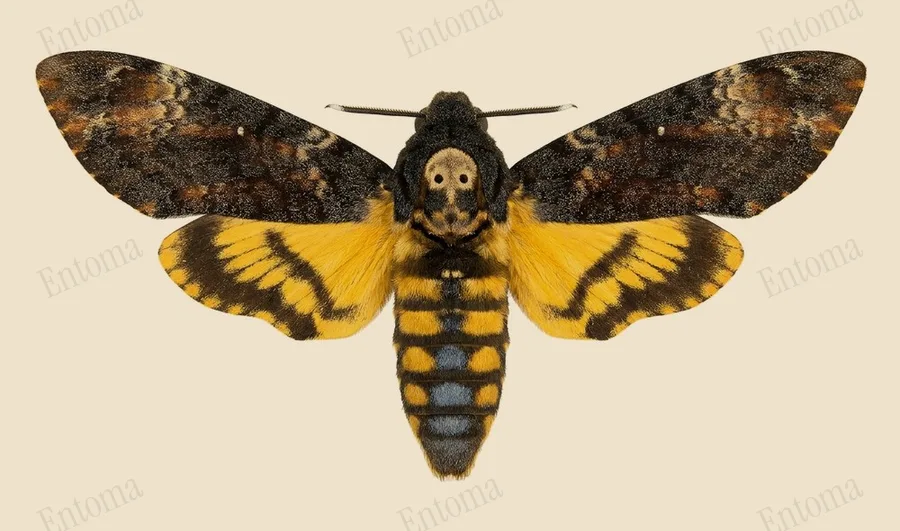
Death's-head hawkmoth
This large hawkmoth sometimes slips into beehives to feed on honey, and if handled it forces air through its proboscis to make a loud, distinctive squeak.
| Where | Farmland, gardens and open countryside |
|---|---|
| Size | 80 to 120 mm wingspan |
| When | June to November |
The Death's-head hawkmoth is among the largest moths recorded in Europe, with brown and yellow-banded wings and a pale, skull-like pattern on the thorax that gives the species its name.
Adults sometimes enter beehives to feed on honey and squeak loudly by forcing air through the proboscis when disturbed or handled. Caterpillars feed on potato and other nightshade family plants and can turn up in vegetable fields and gardens before pupating underground.
Traits
Habitat
Farmland
Colour
Brown, Yellow, Black
Active
Night
To people
Squeaks loudly if handled but has no sting or bite; harmless to people.
Activity through the year
Often confused with
Similar large size at about 80 to 105 mm wingspan and greyish brown tones, but lacks the pale skull-shaped thorax marking and feeds at flowers with a very long proboscis rather than raiding beehives.
Questions
Is the Death's-head hawkmoth dangerous to people?
Squeaks loudly if handled but has no sting or bite; harmless to people.
When can you see the Death's-head hawkmoth?
The Death's-head hawkmoth can be seen from June to November, at night.
Plate retouched from a photo by Didier Descouens, CC BY‑SA 4.0, Wikimedia Commons Licence
The plate on this page is shared under the same licence as its source, CC BY-SA.
Report a mistake in this entry
Butterflies and moths›Hawk moths›Acherontia
Last updated 2026-09-26. Every entry is checked against published sources.