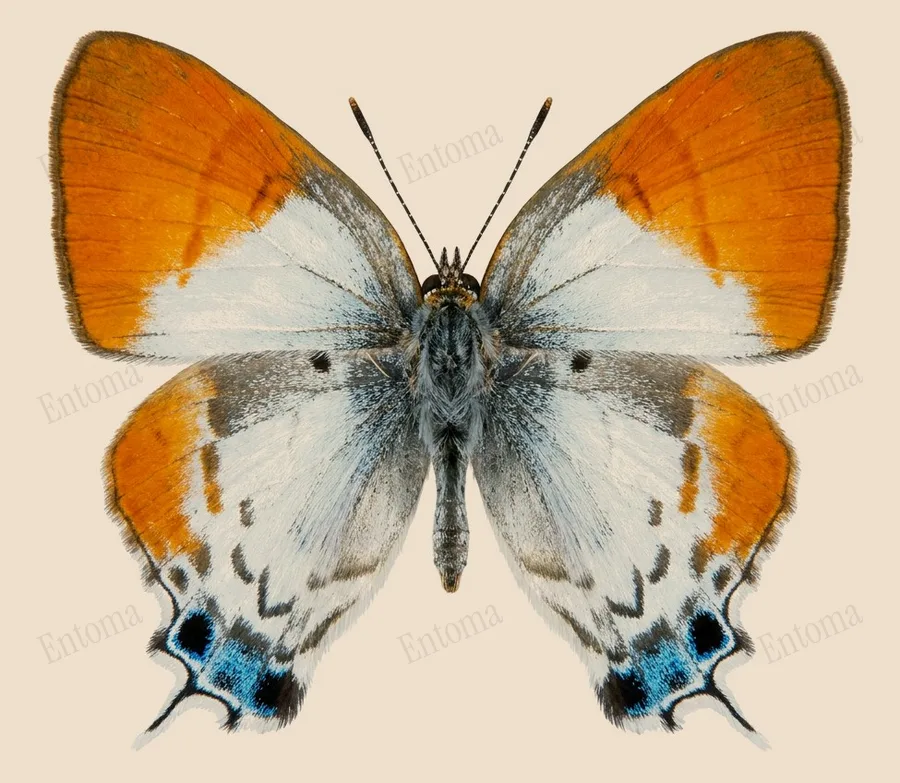
Fluffy tit
Its hindwings carry false eyes, antennae and legs that mimic a head, so an attacking predator strikes the wrong end while the butterfly flies off unharmed.
| Where | Forest edges, streams and clearings |
|---|---|
| Size | 24 to 28 mm wingspan |
| When | January to December |
The fluffy tit is a small lycaenid. Males are black above with pale azure blue at the forewing base and across most of the hindwing, while females are plain pale brown. Long white tails, about twice as long at vein 1b as at vein 2, extend from the hindwing alongside false eye spots and antenna like markings that create a decoy head.
Caterpillars feed on all parts of the flowers of Clerodendrum laevifolium. Adults are most often seen at forest edges and along trail sides in brightly lit conditions, where males puddle on the forest floor.
Traits
Habitat
Woodland
Colour
Black, Blue, Brown
Active
Day
To people
Not known to bother people; males puddle on the forest floor in bright, open conditions.
Activity through the year
Often confused with
A very similar false headed lycaenid, but its longer hindwing tail measures only about 6 mm, against roughly 13 mm on the fluffy tit.
Questions
Is the Fluffy tit dangerous to people?
Not known to bother people; males puddle on the forest floor in bright, open conditions.
When can you see the Fluffy tit?
The Fluffy tit can be seen from January to December, by day.
Plate retouched from a museum specimen photo by Swiss Natural History Collections - SwissNatColl, CC BY 4.0, GBIF Licence
Report a mistake in this entry
Butterflies and moths›Blues and coppers›Zeltus
Last updated 2026-09-27. Every entry is checked against published sources.