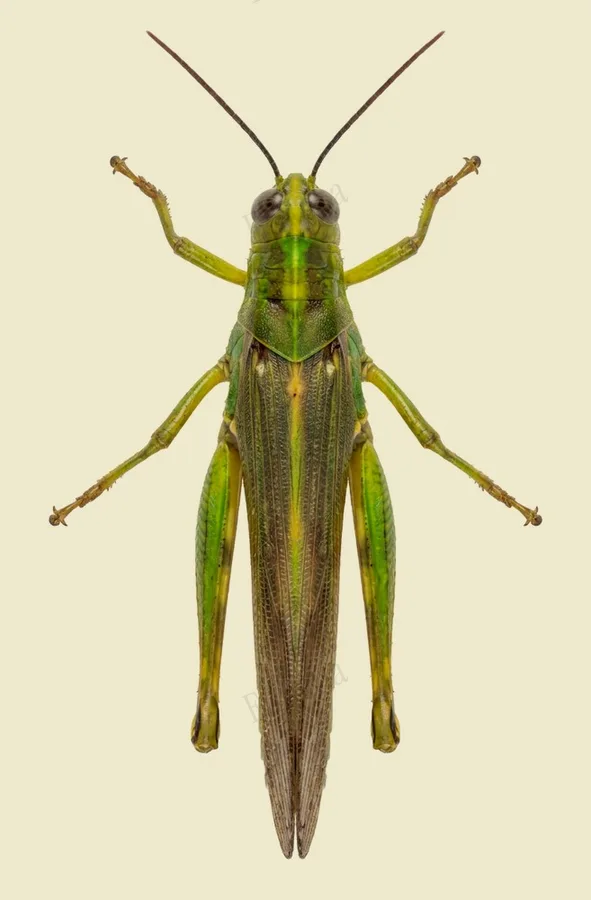
Javanese grasshopper
When this large grasshopper takes flight to escape danger, it flashes hindwings that are rose red, a startling contrast to its usual yellowish brown or green body.
| Where | Forest clearings, trees and shrubs |
|---|---|
| Size | 45 to 75 mm body length |
| When | January to December |
The Javanese Grasshopper is a large, heavily built grasshopper, yellowish brown, yellowish or green with bluish black markings, and hind legs armed with two rows of long, backward-pointing spines tipped in black.
It lives mainly among trees and shrubs in forest clearings and cultivated land, feeding on foliage, and can build up into large numbers on oil palm and rubber where it is treated as a pest.
Traits
Habitat
Woodland
Colour
Brown, Black, Red
Active
Day
To people
Feeds on foliage and can be a plantation pest; harmless to people despite its spiny legs.
Activity through the year
Often confused with
Duller greyish brown with pale yellow stripes along the pronotum and wings and pink tinged hindwings, rather than the bluish black markings and rose red hindwings of the Javanese Grasshopper.
Questions
Is the Javanese grasshopper dangerous to people?
Feeds on foliage and can be a plantation pest; harmless to people despite its spiny legs.
When can you see the Javanese grasshopper?
The Javanese grasshopper can be seen from January to December, by day.
Plate retouched from a photo by portioid, CC BY 4.0, iNaturalist Licence
Report a mistake in this entry
Crickets and grasshoppers›Grasshoppers›Valanga
Last updated 2026-09-27. Every entry is checked against published sources.