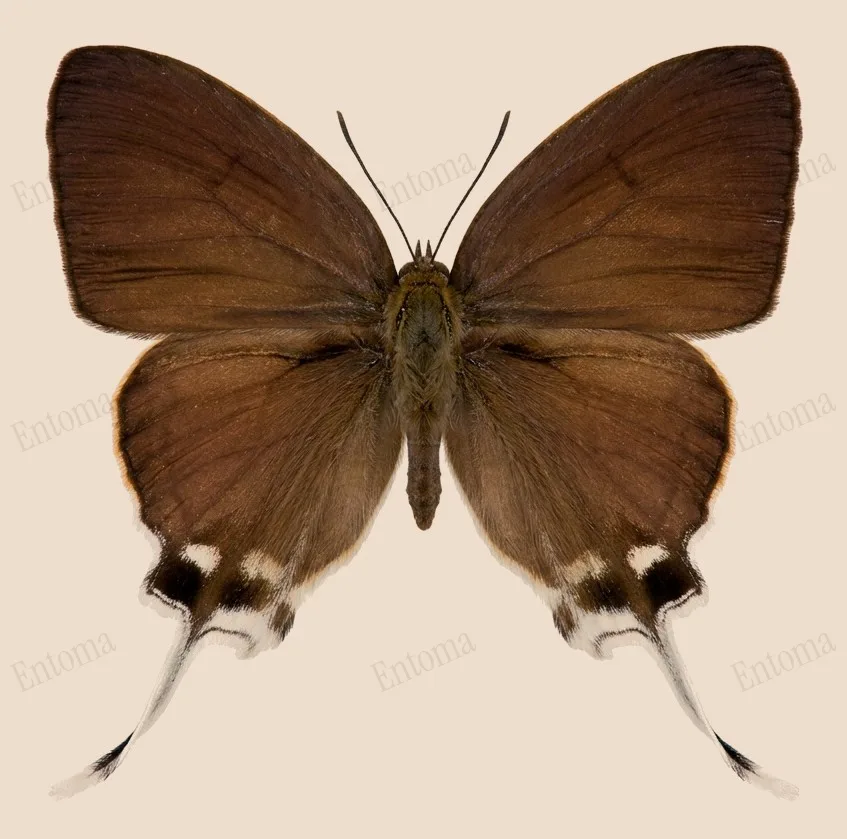
Monkey puzzle
This is the only species in its genus, and its caterpillar has fleshy dorsal bumps said to resemble a tiny monkey's head.
| Where | Forest undergrowth and garden edges |
|---|---|
| Size | 26 to 28 mm wingspan |
| When | January to December |
The Monkey puzzle is dull greyish to reddish brown above with variable white patches on the forewing, larger in females, and shows shiny light blue submarginal scales that fade with age; each hindwing carries three fine tails.
It stays close to its foodplants in forest undergrowth and garden edges, flying with a slow, bouncing motion between shrubs. Caterpillars feed on Ixora flowers and the leaves of Gomphia and Dimorphocalyx.
Traits
Habitat
Woodland
Colour
Brown, Blue, Orange
Active
Day
To people
Does not sting or bite; stays low among shrubs near its foodplants.
Activity through the year
Often confused with
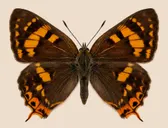
Common silverline has bold silvery-white banded stripes across the underside of both wings, a pattern absent in the plainer-marked Monkey puzzle.
Questions
Is the Monkey puzzle dangerous to people?
Does not sting or bite; stays low among shrubs near its foodplants.
When can you see the Monkey puzzle?
The Monkey puzzle can be seen from January to December, by day.
Plate retouched from a museum specimen photo by Finnish Museum of Natural History - Zoology Unit, CC BY 4.0, GBIF Licence
Report a mistake in this entry
Butterflies and moths›Blues and coppers›Rathinda
Last updated 2026-09-27. Every entry is checked against published sources.