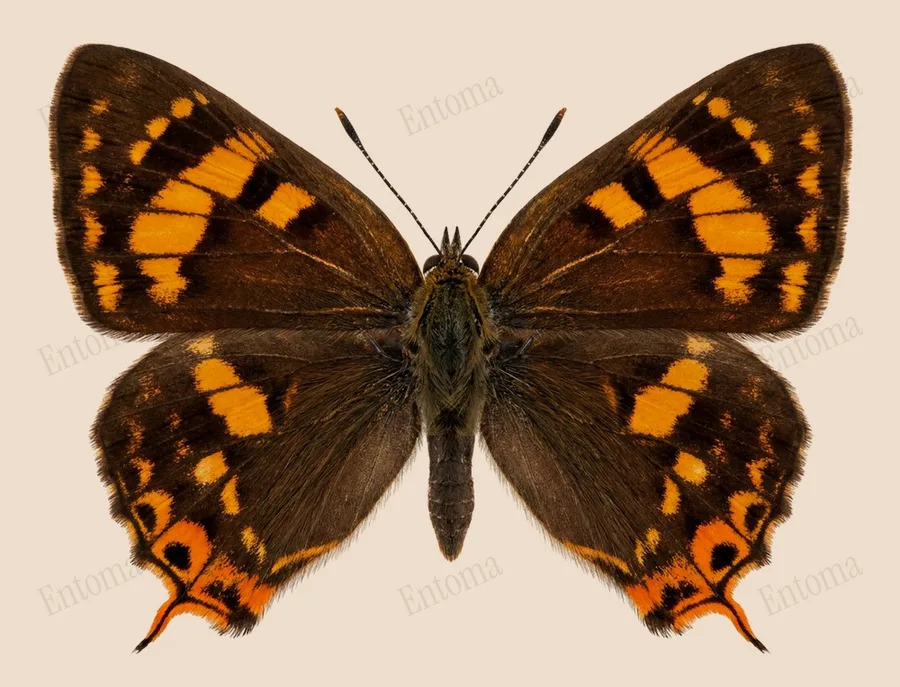
Common silverline
The Common silverline breeds on thorny Ziziphus and Cadaba shrubs; plain dark brown above, its underside carries fine silver-white lines that give the species its name.
| Where | Dry scrub, hedgerows and gardens |
|---|---|
| Size | 26 to 34 mm wingspan |
| When | January to December |
The Common silverline is a small lycaenid butterfly, plain dark brown above with a faint violet sheen, and marked below with fine parallel silver-white striae typical of the silverline group.
Caterpillars feed on a range of thorny shrubs and trees including Ziziphus, Cadaba and Cassia, and the adult is a common, wide-ranging butterfly of open scrub, hedgerows and cultivated edges across South and Southeast Asia.
Traits
Habitat
Farmland
Colour
Brown, White
Active
Day
To people
A common, easily approached butterfly of scrub and gardens; safe to observe up close.
Activity through the year
Often confused with
Underside band nearest the tornus thickens into a rounded club-shaped mark, unlike the more evenly spaced parallel silver-white lines running across the Common silverline's underside.
Questions
Is the Common silverline dangerous to people?
A common, easily approached butterfly of scrub and gardens; safe to observe up close.
When can you see the Common silverline?
The Common silverline can be seen from January to December, by day.
Plate retouched from a museum specimen photo by Finnish Museum of Natural History - Zoology Unit, CC BY 4.0, GBIF Licence
Report a mistake in this entry
Butterflies and moths›Blues and coppers›Cigaritis
Last updated 2026-09-27. Every entry is checked against published sources.