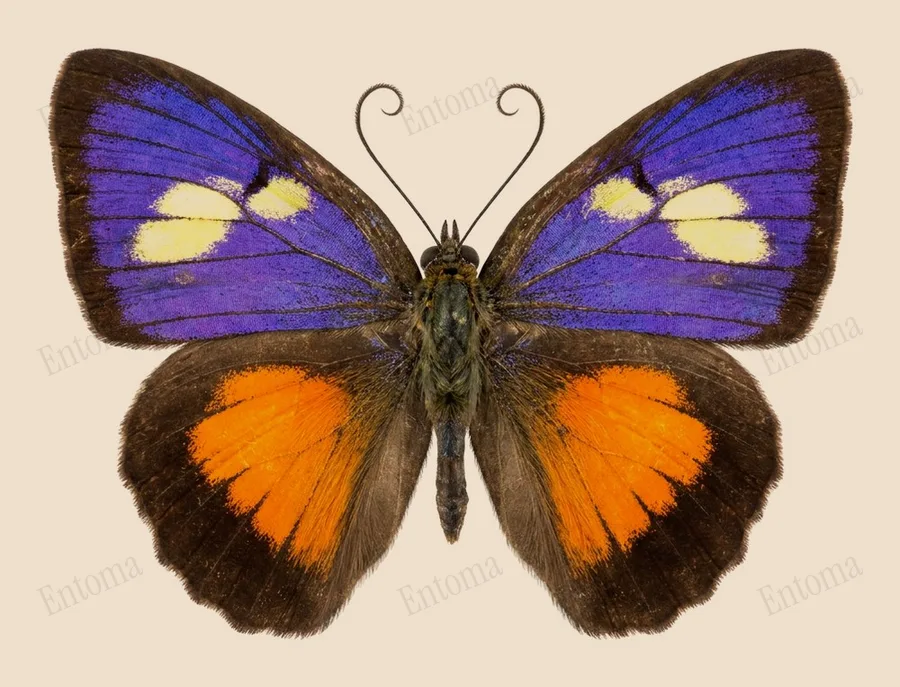
Common posy
Its polyphagous caterpillars occur in two colour forms, green or pink, and feed on unrelated plants including a wild longan tree and a spike oak.
| Where | Primary and secondary rainforest |
|---|---|
| Size | 20 to 35 mm wingspan |
| When | January to December |
The common posy is a small lycaenid. Males show dark brown forewings and iridescent blue hindwings, while females are plain dark brown with only a faint orange patch in some individuals. On the underside both sexes share orange forewings and white hindwings marked with bold black bands, with blue scaling and black centred white tails along the tornal edge.
Caterpillars are polyphagous, feeding on the young leaves of several unrelated plants, and occur in green or pink forms. Adults bask with their wings open flat in sunlit clearings of primary and secondary rainforest, and fly with a distinctive hopping motion.
Traits
Habitat
Woodland
Colour
Brown, Blue, Orange
Active
Day
To people
Not known to bother people; adults bask openly in sunlit forest clearings.
Activity through the year
Often confused with
On the underside hindwing the space between the two black stripes forming the cell end bar is white on this species, rather than filled in with black as on the common posy; males are also dull purple above rather than bright blue.
Questions
Is the Common posy dangerous to people?
Not known to bother people; adults bask openly in sunlit forest clearings.
When can you see the Common posy?
The Common posy can be seen from January to December, by day.
Plate retouched from a museum specimen photo by Finnish Museum of Natural History - Zoology Unit, CC BY 4.0, GBIF Licence
Report a mistake in this entry
Butterflies and moths›Blues and coppers›Drupadia
Last updated 2026-09-27. Every entry is checked against published sources.