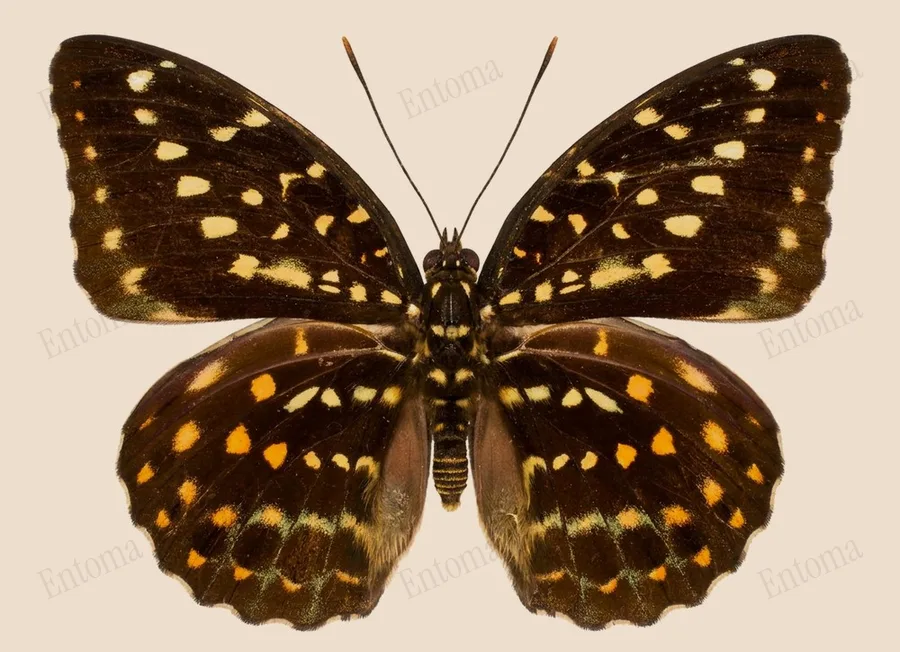
Common archduke
Male and female Common archdukes look so different they were once mistaken for separate species, and only their antenna tip colour separates them from a near identical relative.
| Where | Shaded forest paths and clearings |
|---|---|
| Size | 80 to 90 mm wingspan |
| When | January to December |
Male Common archdukes are velvety black with iridescent blue green to violet margins, while females are larger and dark brown with rows of small yellowish white spots, a difference striking enough that the two sexes were once described as different species.
Adults favour shaded paths, clearings and the edges of primary forest, are often seen standing on the forest floor in sunny gaps, and range across the Indomalayan realm from India and China to the Philippines and Indonesia.
Traits
Habitat
Woodland
Colour
Black, Blue, Brown
Active
Day
To people
Not known to bother people; it feeds at rotting fruit and damp ground rather than approaching humans.
Activity through the year
Often confused with
Has all black antenna tips, whereas the Common archduke has orange yellow antenna tips.
Questions
Is the Common archduke dangerous to people?
Not known to bother people; it feeds at rotting fruit and damp ground rather than approaching humans.
When can you see the Common archduke?
The Common archduke can be seen from January to December, by day.
Plate retouched from a museum specimen photo by Swiss Natural History Collections - SwissNatColl, CC BY 4.0, GBIF Licence
Report a mistake in this entry
Butterflies and moths›Brush-footed butterflies›Lexias
Last updated 2026-09-27. Every entry is checked against published sources.