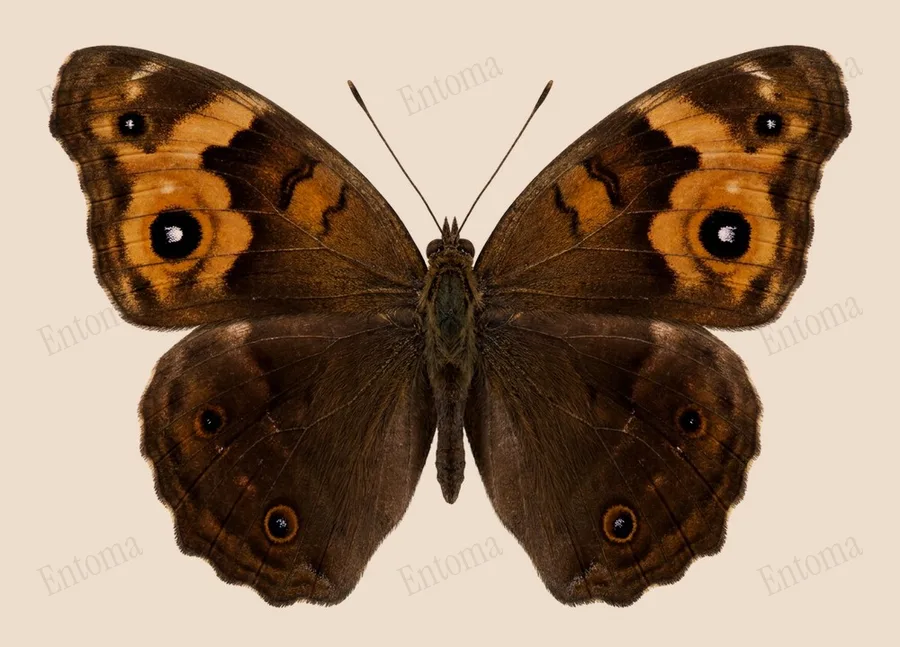
Common evening brown
The Common evening brown flies only in the low light of dawn and dusk, then vanishes by settling motionless among dead leaves within seconds.
| Where | Forest edges, thickets and gardens |
|---|---|
| Size | 50 to 70 mm wingspan |
| When | January to December |
The Common evening brown is a rich brown butterfly with a somewhat falcate forewing tip and a row of dark eyespots along the underside of both wings, the number and size of these eyespots shifting between a boldly marked wet season form and a paler, more angular dry season form. At rest with wings closed it is easily mistaken for a dead leaf.
Caterpillars feed on grasses, including rice and guinea grass, and adults are rarely seen by day, instead flying low and fast at dawn and dusk before dropping into thickets and dense vegetation to rest, occasionally coming to lights near houses.
Traits
Habitat
Woodland
Colour
Brown, Orange
Active
Day and night
To people
Harmless to handle; adults are rarely seen resting in the open, favouring shaded thickets by day.
Activity through the year
Often confused with
The Dark evening brown shows a rounded, well defined pale patch near the forewing tip, while the Common evening brown has two black subapical spots edged with a rusty, broken line instead of a plain pale patch.
Questions
Is the Common evening brown dangerous to people?
Harmless to handle; adults are rarely seen resting in the open, favouring shaded thickets by day.
When can you see the Common evening brown?
The Common evening brown can be seen from January to December, by day and at night.
Plate retouched from a museum specimen photo by Swiss Natural History Collections - SwissNatColl, CC BY 4.0, GBIF Licence
Report a mistake in this entry
Butterflies and moths›Brush-footed butterflies›Melanitis
Last updated 2026-09-27. Every entry is checked against published sources.