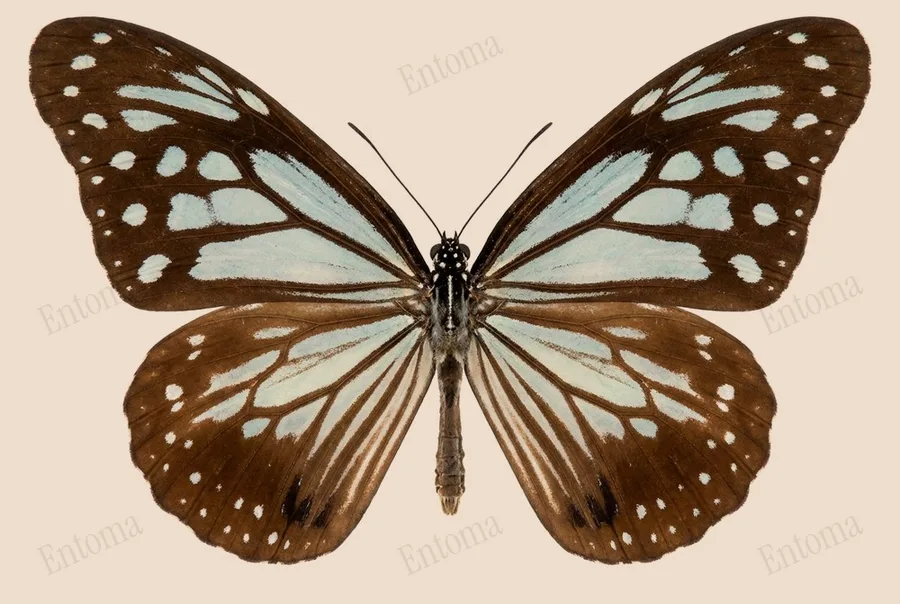
Blue glassy tiger
Its caterpillars feed only on toxic Tylophora vines growing at the edge of mangroves, and the plant's chemicals stay with the butterfly for life.
| Where | Coastal mangroves and forest edges |
|---|---|
| Size | 65 to 80 mm wingspan |
| When | January to December |
The Blue glassy tiger has black wings crossed with translucent bluish white streaks and spots, and a dark transverse bar cutting through one white streak in the forewing cell separates it from the similar Dark glassy tiger.
Adults fly with a slow, gliding flight and are usually found in coastal mangroves and at forest edges across South and Southeast Asia, where the caterpillars' toxic diet protects both stages from predators.
Traits
Habitat
Coast
Colour
Black, White, Blue
Active
Day
To people
Not known to bother people; its slow flight makes it easy to watch without disturbing it.
Activity through the year
Often confused with
Lacks the transverse black bar in the forewing cell that crosses a white streak in the Blue glassy tiger, showing instead a long pale streak above the wing cell.
Questions
Is the Blue glassy tiger dangerous to people?
Not known to bother people; its slow flight makes it easy to watch without disturbing it.
When can you see the Blue glassy tiger?
The Blue glassy tiger can be seen from January to December, by day.
Plate retouched from a museum specimen photo by Swiss Natural History Collections - SwissNatColl, CC BY 4.0, GBIF Licence
Report a mistake in this entry
Butterflies and moths›Brush-footed butterflies›Ideopsis
Last updated 2026-09-27. Every entry is checked against published sources.